By Joe Crisara, Author of What Should We Do? and Co-Founder of Service MVP
Short answer
What should a service manager do the day after technician training?
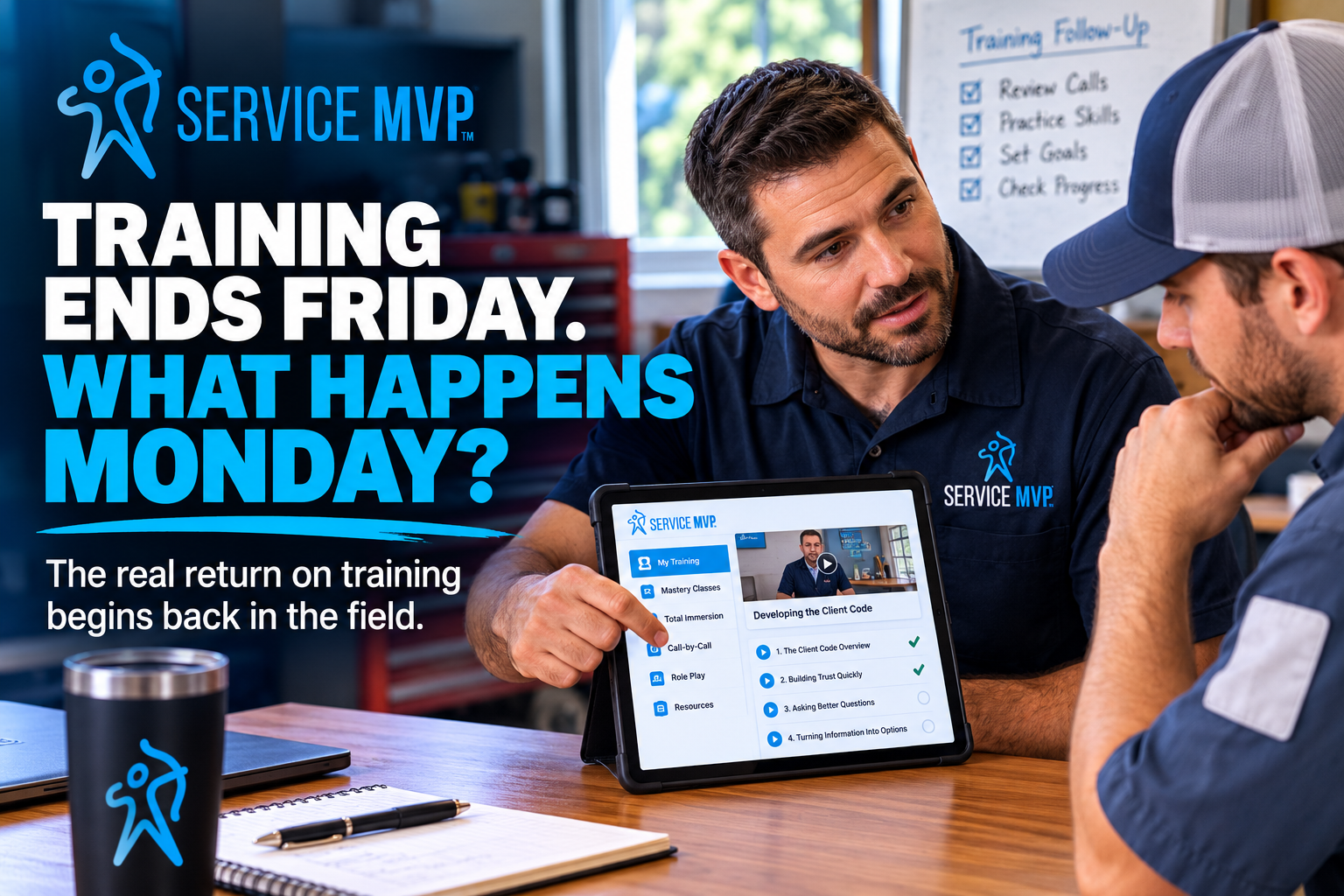
The day after technician training is when a service manager's most important work begins. Before technicians return to their normal routines, managers should identify what each person learned, choose one behavior to reinforce, create an opportunity to practice it, and establish a plan to follow up on actual service calls. Without that reinforcement, even excellent HVAC, plumbing, and electrical technician training can become an expensive event instead of a lasting improvement.
Your Technician Just Finished Training. Now What?
Imagine spending thousands of dollars sending your technicians to a training program.
They spend several days learning new communication skills, practicing customer conversations, and discovering better ways to diagnose problems and present solutions.
They come back excited.
They're motivated.
They're ready to make changes.
And then Monday morning arrives.
The phones start ringing.
Dispatch fills the schedule.
A customer has an emergency.
Someone calls out sick.
And before you know it, your technicians are back doing exactly what they were doing before training.
Sound familiar?
I've watched this happen in home service companies for years.
And here's something I want every contractor to understand:
The value of training isn't determined by how excited your employees are when they leave. It's determined by what they do differently when they return.
That's why the first day after training is so important.
1. Don't Ask, "How Was Training?" Ask, "What Are You Going to Do Differently?"
One of the first things managers do when technicians return from training is ask:
"How was it?"
And the technician says:
"It was great!"
That's nice.
But it doesn't tell you anything about whether the training will improve performance.
Instead, ask questions that require the technician to think about what they've learned.
What was the most important thing you discovered?
What did you realize you were doing differently from the way you were taught?
What skill do you feel more confident about?
What do you still need to practice?
And most importantly:
What are you going to do differently on your very next service call?
That last question matters because it turns training from information into action.
If a technician can't explain what they're going to change, the manager needs to help them identify a starting point.
2. Choose One Skill to Reinforce First
I love what happens during Total Immersion.
Technicians learn how to connect with homeowners, perform a more balanced diagnosis, communicate their findings, present meaningful choices, and handle customer concerns without pressure.
There's a lot to learn.
But here's the mistake I don't want managers making when their technicians return.
Trying to improve everything at once.
Imagine telling a technician:
"Starting tomorrow, I want you to ask better questions, improve your diagnosis, explain everything more clearly, present six options, handle objections differently, and increase your average ticket."
That's overwhelming.
And it doesn't give the technician a clear starting point.
Instead, identify one skill that will make the biggest difference.
Maybe it's learning how to ask better discovery questions.
Maybe it's explaining the diagnosis in a way homeowners understand.
Maybe it's presenting meaningful choices instead of offering only one repair.
Choose one.
Practice it.
Coach it.
And once the technician demonstrates consistency, move to the next skill.
One behavior practiced consistently is more valuable than ten behaviors discussed once.
3. Have the Technician Demonstrate What They Learned
Here's a question for every service manager:
Would you allow a technician to perform a complicated repair simply because they told you they understood how to do it?
Probably not.
You'd want to see them demonstrate the skill.
The same principle applies to customer communication.
If your technician learned how to present options, have them practice presenting options.
If they learned how to ask better discovery questions, roleplay the opening of a service call.
If they learned how to explain the difference between repairing and replacing a system, have them demonstrate that conversation.
And don't just listen for whether they use the right words.
Pay attention to whether they're communicating naturally.
Do they sound confident?
Are they listening?
Are they asking questions that invite the homeowner to participate?
Can they explain the value without sounding like they're reading from a script?
That's the difference between memorizing information and developing a skill.
We explored this in Why Knowing What to Say Isn't Enough: Your Technicians Need to Practice It.
If a technician can't comfortably demonstrate a skill during practice, it's unrealistic to expect them to perform it perfectly under pressure in a customer's home.
4. Give Them a Specific Assignment for Their Next Service Call
After practicing, the technician needs an assignment.
Not something vague like:
"Remember what you learned."
Something measurable.
For example:
"On your next three service calls, I want you to ask the homeowner what concerns them most about the problem before you begin presenting solutions."
Or:
"On your next call, I want you to explain your diagnosis and ask the homeowner to confirm that they understand what you've found."
Or:
"Before presenting a price, I want you to explain the meaningful choices available to the customer."
Now the technician has something specific to work on.
And the manager has something specific to follow up on.
This is especially important when technicians are learning to present solutions.
As we explain in Stop Giving Homeowners One Price: Why Service Technicians Should Present Options, homeowners deserve to understand the choices available to them.
But knowing that philosophy and consistently applying it are two different things.
That's why assignments matter.
5. Follow Up Before Old Habits Take Over
Here's where most companies lose the value of their training investment.
The technician returns.
The manager gives them an assignment.
And then nobody talks about it again for two weeks.
By then, old habits may have returned.
That's why I believe so strongly in call-by-call coaching.
The goal is to create a short feedback loop between practicing a skill, applying it on a service call, and discussing what happened.
After the technician's next call, ask:
"Did you use the skill we practiced?"
"What happened when you tried it?"
"What did the homeowner say?"
"What felt natural?"
"What was difficult?"
"What would you do differently next time?"
You don't need to turn every conversation into an hour-long meeting.
Sometimes five or ten minutes of focused coaching can make an enormous difference.
But those conversations need to happen consistently.
If the only time you discuss training is when a technician makes a mistake, you're missing most of your opportunities to develop them.
6. Measure the Behavior Before You Measure the Revenue
Every business owner wants training to produce results.
Higher average tickets.
Better closing percentages.
Fewer callbacks.
More satisfied customers.
And there's nothing wrong with measuring those things.
But I want managers to understand something.
Revenue is a result.
It's not the behavior that produces the result.
Imagine a technician comes back from training and begins asking better questions.
They discover more about what homeowners need.
They explain their findings more clearly.
And they start presenting meaningful options.
Those are positive changes.
But what if their average ticket doesn't immediately increase?
Does that mean the training failed?
Of course not.
The manager needs to recognize whether the technician is applying the new skills consistently.
Over time, those behaviors can contribute to stronger business performance.
But if you focus only on revenue, you may overlook the progress that's happening underneath the numbers.
Coach the behavior. Measure the results. Understand the relationship between the two.
7. Make Coaching Part of the Weekly Routine
The biggest mistake a company can make is treating training as something separate from daily operations.
Training shouldn't be an event that happens once or twice a year.
It should be part of how the business operates.
That doesn't mean pulling technicians out of the field for hours every week.
It means building small, consistent opportunities for improvement into the schedule.
A few minutes of practice before the first call.
A short coaching conversation after a challenging appointment.
A roleplay during a team meeting.
A review of one successful customer interaction.
Recognition when a technician applies a new skill.
And a clear plan for what comes next.
At Service MVP, our approach combines training, coaching, and accountability because those three things work together.
Training introduces the skill.
Coaching helps the technician improve it.
Accountability ensures the skill continues to be practiced.
When those pieces become part of your company's routine, improvement no longer depends entirely on the excitement of attending a training event.
8. Don't Forget to Develop the Manager, Too
There's one more part of this conversation that business owners often overlook.
What if your technicians attend excellent training, but their manager doesn't understand what they were taught?
How can that manager reinforce the right behaviors?
How can they coach a skill they've never practiced?
How can they recognize improvement if they don't know what great performance should look like?
This is why leadership development is just as important as technician training.
Managers need to understand the process their technicians are expected to follow.
They need to know how to observe performance.
They need to know how to give feedback without creating defensiveness.
And they need to know how to help employees develop confidence through practice.
Because the person responsible for reinforcing training has to understand the training, too.
You can't build a coaching culture if your managers don't know how to coach.
A Simple Plan for the First Week After Training
If your technicians are returning from a training event, here's the process I'd recommend.
Day 1: Identify the improvement.
Meet briefly with each technician. Ask what they learned and identify one skill they will begin practicing immediately.
Day 2: Practice the skill.
Have the technician demonstrate the behavior through a roleplay or practice exercise. Give specific feedback.
Day 3: Apply it in the field.
Assign the technician to use the skill during actual customer interactions.
Day 4: Review and coach.
Discuss what happened. Recognize improvements and address any difficulties.
Day 5: Reinforce and plan ahead.
Review the week's progress, celebrate what improved, and decide whether the technician should continue practicing the same skill or move to the next one.
This doesn't require an elaborate training department.
It requires a manager who is committed to developing people.
And a process that makes improvement part of the job.
The Day After Training Is Where the Real Return Begins
I love seeing technicians develop new skills during Total Immersion.
I love watching someone who was uncomfortable communicating with customers suddenly realize they can do it.
I love seeing technicians gain confidence as they learn to ask better questions and present meaningful solutions.
But the real success doesn't happen in the training room.
It happens when those technicians return to their customers.
It happens when they apply what they've learned.
And it happens when their managers continue helping them improve.
If you're investing in technician training, don't let that investment end when the class is over.
The training event is the beginning. The coaching that follows is what makes it last.
Turn Technician Training Into Lasting Performance
At Service MVP, we help HVAC, plumbing, electrical, and other home service businesses develop their people through a combination of practical training, ongoing coaching, and accountability.
Our Total Immersion training helps technicians build the skills they need to create better customer experiences.
And our Service MVP Coaching programs help managers and business owners reinforce those skills long after training ends.
Because investing in your people shouldn't produce a temporary improvement.
It should help build a stronger company.
