
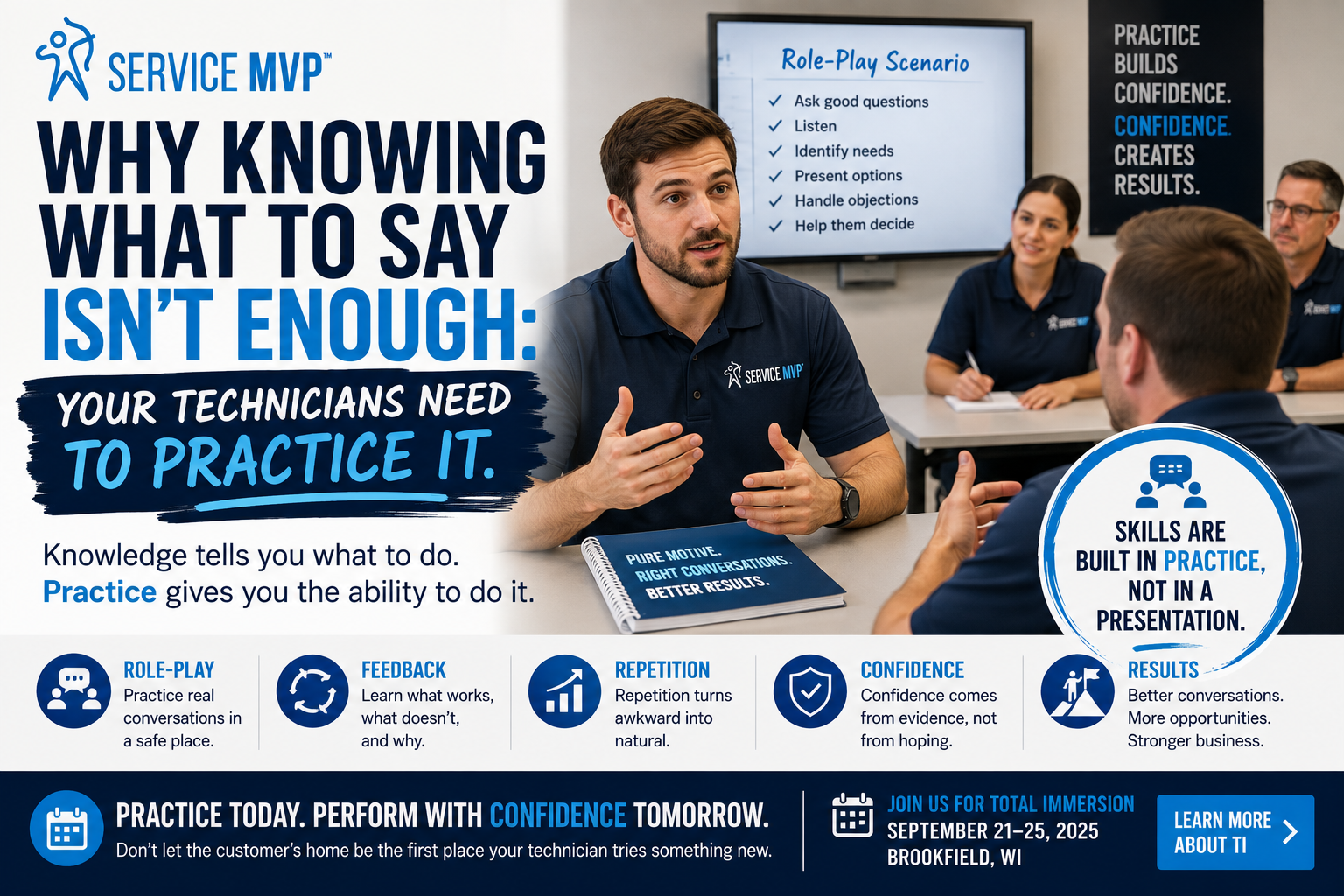
Why Knowing What to Say Isn’t Enough: Your Technicians Need to Practice It
Why Knowing What to Say Isn’t Enough: Your Technicians Need to Practice It
By Joe Crisara, Author of What Should We Do? and Co-Founder of Service MVP
Most home service companies have told their technicians what they want them to do.
Ask better questions.
Listen to the homeowner.
Identify opportunities.
Explain what you found.
Present multiple options.
Don't prejudge the customer.
Don't apologize for the price.
Handle objections professionally.
Let the homeowner make the decision.
The problem usually isn't that technicians have never heard these things.
The problem is doing them when there's a real homeowner sitting across the kitchen table.
Because knowing what to do and being able to do it under pressure are two very different things.
Knowledge tells you what to do. Practice gives you the ability to actually do it.
That's why technician communication training can't end in the classroom.
It has to be practiced.
You Wouldn't Train Technical Skills This Way
Imagine hiring a brand-new HVAC technician and handing them a book about diagnosing air-conditioning systems.
They read it.
You give them a quiz.
They get 100%.
Would you immediately send them alone to diagnose your best customer's system?
Probably not.
You'd want them to see the equipment.
Use the tools.
Make diagnoses.
Make mistakes somewhere safe.
Work alongside someone experienced.
Receive feedback.
And repeat the process until they demonstrate that they can actually perform the skill.
We understand this perfectly when we're talking about technical training.
But somehow, when it comes to communication, we often think a meeting, video, script, or seminar is enough.
It isn't.
Communication is a skill.
And skills have to be practiced.
The Homeowner Doesn't Follow Your Script
Scripts can be useful.
They can give technicians language when they're learning a new process and help establish consistency across a team.
But here's the problem:
Homeowners don't have copies of the script.
Your technician asks a question.
The homeowner gives an answer nobody expected.
Now what?
The homeowner interrupts.
The conversation changes direction.
A spouse walks into the room.
Someone asks why the repair costs so much.
The homeowner says their brother-in-law can do it cheaper.
They want to know what the technician would choose.
They say they need to think about it.
Or they simply sit there silently.
That's when memorization ends and skill begins.
A technician who understands the purpose behind the conversation can adapt.
A technician who only memorized the words may freeze, rush, become defensive, or abandon the process entirely.
That's why the goal of training shouldn't be to create technicians who can repeat the right words.
It should be to create technicians who can have the right conversation.
Practice Creates a Safe Place to Get It Wrong
This is one of the biggest reasons we believe in role-play at Service MVP.
Nobody loves making mistakes.
But mistakes are part of developing a skill.
So here's the question:
Where would you rather your technician make them?
In training?
Or in the customer's home?
During practice, we can stop the conversation.
Try the question again.
Change the wording.
Point out where the technician started talking instead of listening.
Notice when they accidentally prejudged the customer.
Recognize when they rushed through an option.
Talk about why a question didn't work.
Then start over.
There is no angry customer.
There is no lost opportunity.
There is no one-star Google review.
There's just feedback.
And another opportunity to try.
That's incredibly valuable.
Repetition Turns Awkward Into Natural
Anyone who has ever role-played knows what the first few attempts can feel like.
Awkward.
Forced.
Uncomfortable.
That's normal.
The technician is consciously thinking:
What am I supposed to ask next?
Am I saying this correctly?
What did they teach us about this?
But something happens with repetition.
Eventually, they stop thinking so much about the process and start paying attention to the person sitting in front of them.
That's when the conversation becomes natural.
They're listening instead of waiting for their next line.
They're curious.
They're noticing what's important.
They're responding to what the homeowner actually said.
And that's the goal.
We aren't trying to manufacture robotic conversations.
We're practicing the fundamentals enough that technicians can eventually stop thinking about the fundamentals.
Confidence Comes From Evidence
Managers sometimes tell technicians:
“Just be confident.”
But confidence isn't something you can simply order someone to have.
Real confidence usually comes from evidence.
I've done this before.
I've handled this conversation.
I've practiced this.
I know what to do next.
Think about the technician presenting a price we talked about in Your Pricebook Isn't the Problem If Technicians Can't Communicate the Value.
They see a $4,000 option.
If they've never successfully presented something like that before, they may become nervous before the homeowner ever sees it.
But what if they've already practiced the conversation 20 times?
What if they've had someone challenge the price during role-play?
What if they've practiced slowing down instead of becoming defensive?
What if they've learned how to ask another question?
What if they've practiced presenting several appropriate choices instead of trying to force one solution?
Now they're not walking into an unfamiliar situation.
They've been there before.
That's where confidence comes from.
Role-Play Shouldn't Be About Winning
There's also a wrong way to role-play.
Sometimes the person playing the homeowner tries to make the scenario impossibly difficult.
They argue.
They throw objection after objection.
They try to defeat the technician.
Everyone laughs.
And eventually the exercise becomes:
Can the technician beat the customer?
That's not what we're trying to teach.
The homeowner isn't the opponent.
The goal isn't to win an argument.
The goal is to understand what is preventing the homeowner from comfortably making a decision.
That's an important distinction.
If a homeowner says:
“That's too expensive.”
our immediate goal shouldn't be finding the magic sentence that changes their mind.
We should become curious.
What do they mean?
Was the price unexpected?
Do they understand the differences between the options?
Did we fail to communicate something?
Is there another concern?
Or is it simply more than they want to spend?
Those are very different situations.
Good practice teaches technicians to listen and respond, rather than automatically launching into an objection-handling speech.
And we'll go much deeper into that in the next article in this series.
Managers Need Practice Too
There's another side to this that often gets overlooked.
If technicians are expected to practice, leaders need to know how to coach the practice.
A manager can't simply say:
“That wasn't very good. Try again.”
Good coaching is specific.
Where did the conversation change?
What question opened the homeowner up?
Where did the technician begin making assumptions?
Did they listen to the answer?
Did they explain too much?
Did they rush?
Did they create meaningful choices?
Did they give the homeowner enough space to make a decision?
The coach should help the technician discover what worked and what didn't.
That's how practice becomes development rather than criticism.
One Training Day Won't Create a New Habit
This is also why companies sometimes become frustrated with training.
Everyone attends a seminar.
They're excited.
They take notes.
The team comes back energized.
Then three weeks later, everything looks pretty much like it did before.
Was the training bad?
Not necessarily.
The problem may be what happened after the training.
If you want a new behavior in the home, the learning can't stop when the presentation ends.
There has to be repetition.
Coaching.
Observation.
Feedback.
Practice.
Reinforcement.
Again and again.
Eventually the new behavior becomes the normal behavior.
That's when training begins affecting the customer experience—and the business.
The Goal Isn't Better Salespeople
This distinction matters to me.
We're not trying to turn service technicians into slick salespeople.
We're trying to develop better service professionals.
Professionals who listen.
Professionals who investigate.
Professionals who communicate clearly.
Professionals who identify legitimate opportunities.
Professionals who explain choices.
Professionals who don't decide what customers can afford.
Professionals who aren't afraid of the company's pricing.
And professionals who are comfortable allowing the homeowner to make the final decision.
Those abilities don't just improve revenue.
They improve the entire service experience.
Knowing Is the Beginning. Doing Is the Goal.
Over the last few articles, we've built this piece by piece.
Your company needs to understand what it actually costs to provide exceptional service.
Your pricebook needs to keep pace when those costs change.
Your technicians need to know how to communicate the value behind those prices.
But even that isn't enough.
They have to practice doing it.
Because the homeowner doesn't experience what your technician knows.
The homeowner experiences what your technician does.
And there's only one reliable way to get better at doing something.
Practice.
What Would Five Days of Practice Do for Your Team?
This is one of the reasons we created Service MVP's Total Immersion training the way we did.
Total Immersion isn't designed to be five days of sitting in a chair listening to someone talk.
It's an intensive environment where home service professionals can learn, practice, receive feedback, make corrections, and practice again.
The idea is simple:
Don't let the customer's home be the first place your technician tries something new.
Our next Total Immersion takes place September 21–25 in Brookfield, Wisconsin, hosted at Quality Heating, Cooling, Plumbing & Electrical.
If your team already knows what they're supposed to do but isn't consistently doing it in the home, more information may not be the answer.
They may need more practice.
