By Joe Crisara, Author of What Should We Do? and Co-Founder of Service MVP
Short answer
What happens when your best technician is your worst salesperson?
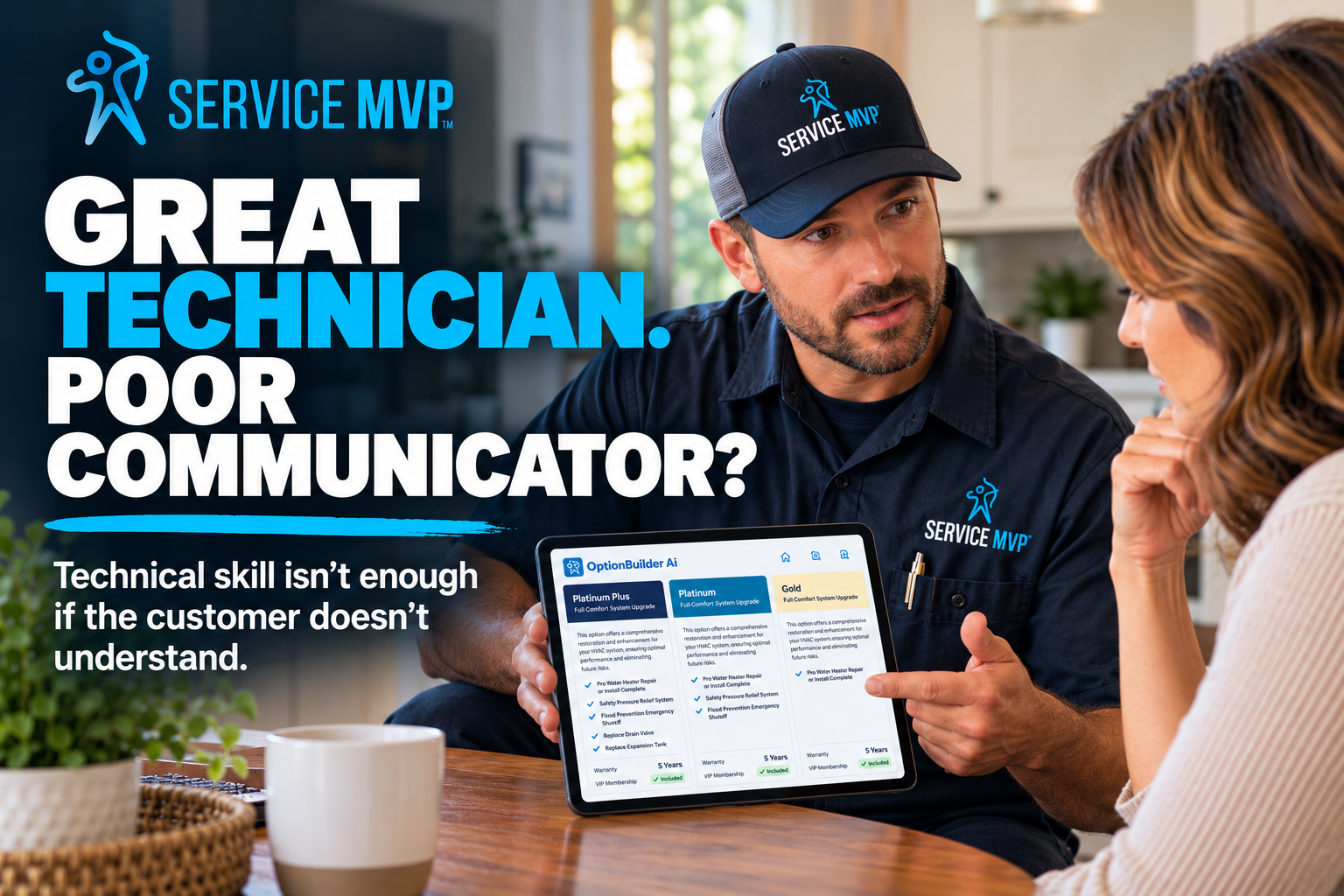
Your best technician isn't necessarily your best salesperson because technical expertise and customer communication are two different skills. A technician may diagnose and repair an HVAC, plumbing, or electrical problem perfectly but still struggle to explain its importance, uncover the homeowner's concerns, or present meaningful solutions. The answer isn't to turn technicians into aggressive salespeople. It's to teach them how to communicate their expertise in a way customers understand and trust.
How Can a Great Technician Struggle So Much With Customers?
I've seen it happen thousands of times.
A home service company has a technician who can fix practically anything.
Give them a complicated electrical problem, a mysterious plumbing leak, or an HVAC system that nobody else can figure out, and they're the person everybody calls.
They're experienced.
They're knowledgeable.
They're dependable.
And the owner loves them.
There's just one problem.
They aren't producing the results the owner expects.
Their average ticket is low.
Customers frequently decline their recommendations.
They rarely present more than one solution.
And when you ask them why the homeowner didn't move forward, they say something like:
"They didn't want to spend the money."
So the owner concludes:
"We've got a great technician, but they're just not a salesperson."
I think that's the wrong conclusion.
The technician may not have a sales problem at all. They may have a communication problem.
And those are two very different things.
Technical Knowledge Doesn't Automatically Create Customer Understanding
Think about what happens when an experienced technician walks into someone's home.
They look at the equipment and immediately begin recognizing things the homeowner doesn't see.
They understand how the system works.
They know which components are failing.
They can anticipate what might happen next.
And they know which repairs would solve the problem.
That's valuable expertise.
But here's the question:
Does the homeowner understand any of it?
The technician might say:
"Your capacitor is weak, the contactor is pitted, and the condenser coil is dirty."
To another technician, that might make perfect sense.
To the homeowner?
Not necessarily.
They may be wondering:
Is that serious?
Does it explain why my house isn't cooling?
Will the system break down?
Do I need to fix everything?
How much is this going to cost?
And why should I trust this recommendation?
If the technician doesn't answer those questions, the customer is left trying to make a decision without understanding the situation.
That's when hesitation begins.
And hesitation is often mistaken for a price objection.
Stop Assuming the Homeowner Knows What You Know
One of the biggest communication mistakes technicians make is assuming that because they've explained something, the customer understands it.
But explaining isn't the same as communicating.
Communication happens when the other person understands what you're trying to convey.
Let me give you an example.
A technician discovers a deteriorating electrical connection inside an HVAC system.
They know the connection could cause intermittent operation or further equipment damage.
But instead of explaining those consequences, they simply tell the homeowner:
"You need a new contactor. It's $425."
Now the homeowner has a decision to make.
But what are they actually deciding?
Whether they want to spend $425 on something they've probably never heard of?
That's not much of a buying experience.
A better approach is to help the customer understand what was discovered, why it matters, and what choices are available.
Not by frightening them.
Not by exaggerating the problem.
But by educating them.
Your technical knowledge creates value only when the homeowner can understand how it relates to their needs.
The Best Technicians Diagnose More Than Equipment
At Service MVP, we teach a concept called Balanced Diagnosis.
It means looking beyond the immediate mechanical problem to understand the complete situation.
Of course, you need to diagnose the equipment.
That's essential.
But you also need to understand the homeowner.
Why did they call today?
How long has the problem been happening?
What have they already tried?
What concerns them most?
Are they planning to stay in the home for another year or another twenty years?
Do they have other concerns about comfort, reliability, efficiency, or safety?
Those questions can change the conversation.
Imagine two homeowners with identical air conditioning problems.
One is preparing to sell the house in three months.
The other has lived there for twenty years and plans to retire in that home.
Would you automatically recommend the same solution to both?
You shouldn't assume their priorities are identical.
The equipment may have the same problem, but the homeowners may have very different needs.
That's why great service begins with discovery.
Not with a sales pitch.
Your Technician's Job Isn't to Decide What the Customer Can Afford
Here's another mistake I see all the time.
The technician finds several legitimate opportunities to improve the system.
Maybe there's an immediate repair.
Maybe there are additional components showing wear.
Maybe there's an efficiency improvement or a longer-term solution worth considering.
But the technician only presents the least expensive repair.
Why?
Because they've already decided what the homeowner can afford.
"They're on a fixed income."
"They've got kids."
"They don't seem like they have much money."
"I don't think they'll want to spend that much."
Now the technician is making financial decisions for someone they barely know.
And the homeowner never even gets to see the choices.
I don't believe that's our job.
Our responsibility is to identify legitimate needs, explain what we've discovered, and help customers understand their options.
Then let them decide.
That's the philosophy behind our article, Stop Giving Homeowners One Price: Why Service Technicians Should Present Options.
When we present meaningful Premium, Mid-Range, and Economy solutions, we're not trying to push someone toward the most expensive choice.
We're giving them control.
And customers deserve that.
Why Some Technicians Resist Learning Communication Skills
I've worked with technicians who initially resisted anything that sounded like sales training.
They'd tell me:
"Joe, I'm a technician. I fix things. I'm not a salesman."
And I understand that reaction.
A lot of technicians entered the trades because they enjoy solving technical problems.
They take pride in their craftsmanship.
They don't want to feel like they're pressuring homeowners into buying something.
And frankly, I don't want them doing that either.
But I ask them a question.
If you discover something important about a customer's system and fail to explain it clearly, have you really completed your job?
What if the homeowner makes a decision without understanding the consequences?
What if they never learn about another solution that would have better addressed their concerns?
What if they decline a recommendation simply because they don't understand its value?
Helping someone make an informed decision is part of providing professional service.
And that doesn't require becoming someone you're not.
It requires learning a skill.
Communication Is a Skill That Can Be Practiced
Here's where business owners sometimes get frustrated.
They send their technicians to training.
They explain how to ask better questions.
They teach them how to present options.
They discuss customer objections.
And then they expect everyone to start doing those things consistently.
But communication skills don't develop that way.
Imagine teaching a technician how to braze copper pipe by showing them a PowerPoint presentation.
Would you send them into the field without letting them practice?
Of course not.
You'd demonstrate the technique.
You'd have them practice.
You'd observe their work.
You'd correct mistakes.
And you'd keep practicing until they developed confidence.
Customer communication deserves the same attention.
Technicians need to practice asking questions.
They need to practice explaining technical problems in everyday language.
They need to practice presenting solutions.
And they need to practice responding when customers have concerns.
We've written about this in Why Knowing What to Say Isn't Enough: Your Technicians Need to Practice It.
You can't expect consistent performance from skills people haven't practiced consistently.
What Should a Service Manager Coach First?
If you have a technically excellent employee who struggles with customer communication, don't overwhelm them by trying to change everything at once.
Start by observing their process.
Are they asking questions before diagnosing?
Are they confirming what matters to the homeowner?
Are they explaining their findings clearly?
Are they presenting meaningful options?
Are they allowing the customer to make an informed decision?
Then identify one behavior that would make the biggest difference.
Maybe the technician needs to ask one more discovery question.
Maybe they need to explain the consequences of a problem before discussing price.
Maybe they need to stop presenting only one solution.
Give them a specific skill to practice.
Observe what happens.
Provide feedback.
And follow up on the next call.
That's how improvement becomes repeatable.
Not through another lecture about closing percentages.
Through coaching.
What If Your Best Technician Became Your Best Communicator?
Now imagine what happens when that technically gifted employee develops strong communication skills.
They already know how to diagnose difficult problems.
They already understand the equipment.
They already take pride in their work.
Now they can explain their findings in a way homeowners understand.
They can uncover customer concerns without making assumptions.
They can present personalized solutions with confidence.
And they can help people make informed decisions without pressure.
Think about the difference that could make.
For the technician.
For the homeowner.
And for the company.
That's why I believe so strongly in teaching communication as part of professional development.
Technical expertise earns the opportunity to serve. Communication helps the homeowner understand the value of that service.
Don't Turn Your Technicians Into Salespeople. Help Them Become Better Service Professionals.
If your best technician is struggling to generate revenue, don't immediately assume they need to become a different kind of person.
They may already have the most difficult part of the job mastered.
They know how to solve problems.
What they need is the ability to translate that expertise into an experience the homeowner understands and appreciates.
Teach them to listen.
Teach them to ask better questions.
Teach them to explain their diagnosis.
Teach them to present meaningful choices.
And coach those skills until they become habits.
Because when a technician combines technical excellence with excellent communication, something important happens.
They stop feeling like they have to sell.
And start realizing how much more effectively they can serve.
Help Your Technicians Turn Technical Expertise Into Customer Confidence
At Service MVP, our Total Immersion training helps home service professionals develop the communication, diagnosis, and options-presenting skills that create better customer experiences.
And through Service MVP Coaching, we help companies reinforce those skills with ongoing practice, feedback, and accountability.
Because great technicians deserve great communication skills, too.
