
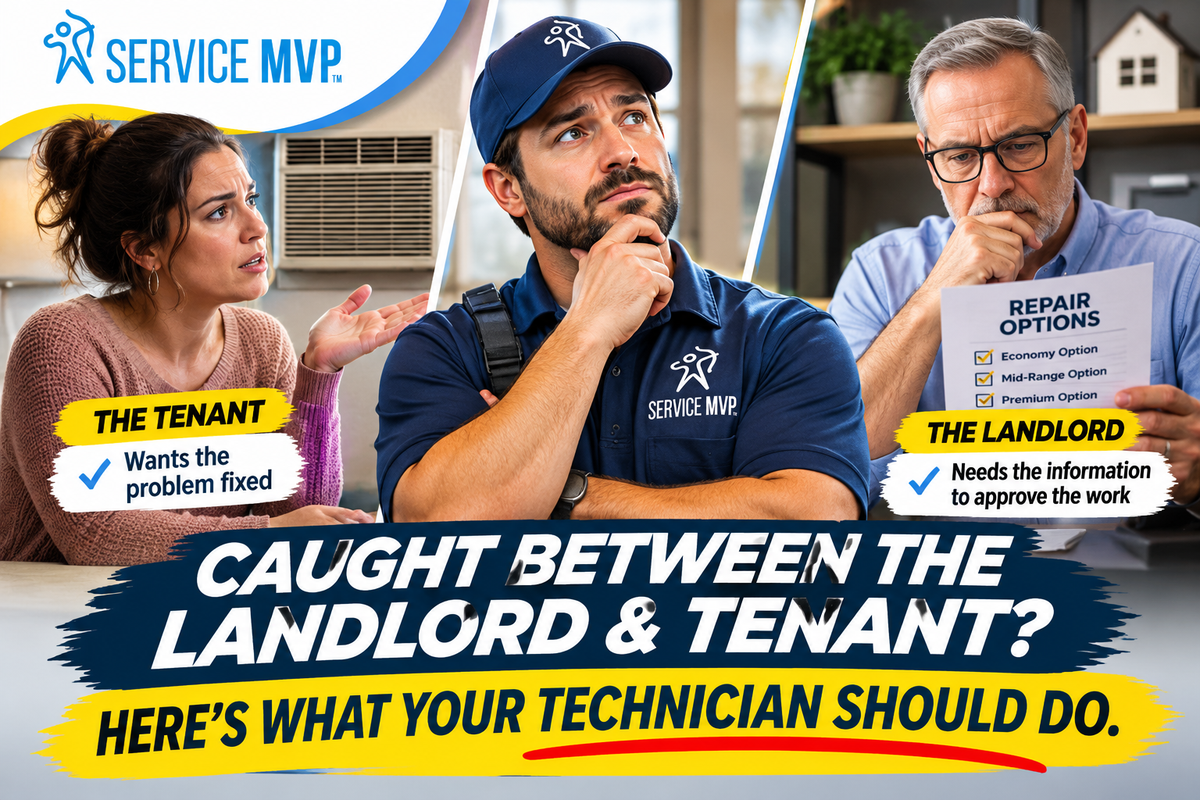
Your Technician Is Caught Between the Landlord and Tenant. Now What?
Your Technician Is Caught Between the Landlord and Tenant. Now What?
By Joe Crisara, America's Service Sales Coach and Author of What Should We Do?
Your HVAC technician arrives at a rental property.
The tenant answers the door.
"The air conditioner hasn't worked for a week. I've been trying to get my landlord to fix it."
Your technician immediately thinks:
Great. Another landlord call.
The tenant doesn't own the equipment.
The landlord isn't there.
And the person paying for the repair probably wants the cheapest possible solution.
So your technician diagnoses the immediate problem, calls the landlord, quotes the repair, and hopes to get approval.
Sound familiar?
Here's what I want you to understand:
A landlord–tenant service call isn't necessarily a bad opportunity. Your technician may simply be approaching it the wrong way.
During a recent Service MVP training session, I explained why landlord–tenant calls can actually create opportunities for more comprehensive repairs, equipment improvements, and stronger customer relationships.
But it starts with understanding something many technicians overlook.
There are two customers involved in the experience, and both matter.
Why HVAC and Plumbing Technicians Struggle With Landlord–Tenant Calls
Most technicians are comfortable when the homeowner is also the person paying for the repair.
They diagnose the problem.
They explain what they found.
They present the options.
The homeowner makes a decision.
But rental properties introduce another layer.
The person experiencing the problem may not have authority to approve the work.
And the person approving the work may not understand how the problem is affecting the people living there.
That creates a communication gap.
The tenant wants the problem resolved.
The landlord wants to protect the property and manage expenses.
The technician is caught in the middle.
And when technicians don't have a strategy for managing that situation, they often default to the smallest repair.
But here's the mistake:
They assume the landlord only cares about price before they've even explained the complete problem.
That's not a diagnosis of the customer's needs.
That's an assumption.
Mistake #1: Ignoring the Tenant Because They Aren't Paying
One of the biggest mistakes I see technicians make is avoiding meaningful conversations with tenants.
They think:
"The tenant isn't paying the bill, so why should I spend time talking to them?"
Because the tenant is the person using the equipment.
Think about it.
The landlord may not know that the upstairs bedroom has been uncomfortable for months.
They may not realize the water pressure has been getting worse.
They may not know the lights have been flickering or that the drain backs up every time someone uses the washing machine.
The tenant experiences those problems every day.
The landlord owns the property, but the tenant often understands how the property is actually performing.
That's valuable information.
And if your technician ignores the tenant, they may miss important details that could lead to a better diagnosis and more appropriate solutions.
Step 1: Start by Understanding the Tenant's Experience
When I arrive at a rental property, I want to begin by showing respect to the person who made time for the appointment.
Remember, they may have rearranged their schedule.
They may have taken time away from work.
They may have been dealing with an uncomfortable home for several days.
So I might begin with:
"Thanks for taking the time to meet with me today. I know you've probably had to rearrange your schedule, and I appreciate the opportunity to help."
Then I'd ask:
"Can you tell me what's been happening with the air conditioning?"
The tenant might explain that the system stopped cooling a week ago.
But don't stop there.
Ask:
"Was the system working properly before that?"
"Have you noticed certain rooms being warmer than others?"
"Has this happened before?"
"What has been the biggest inconvenience since the system stopped working?"
These questions help your technician understand the complete experience.
And they may uncover issues the landlord hasn't heard about.
The objective isn't to turn the tenant against the landlord.
It's to understand the problem accurately.
Step 2: Never Shortcut the Diagnosis Because It's a Rental Property
This may be the most important technical lesson from the entire training.
A rental property deserves the same professional diagnostic standards as an owner-occupied home.
Let me repeat that.
Your technician should not perform a less thorough diagnosis simply because the landlord is paying.
Suppose the air conditioner isn't running.
The technician finds a failed electrical connection in the outdoor unit.
They could replace the damaged component and restore operation.
But what if the equipment is 28 years old?
What if the filter is severely restricted?
What if there are additional airflow problems?
What if the technician identifies other conditions that could affect system performance or safety?
Those findings deserve appropriate investigation and documentation.
A symptom isn't necessarily the entire problem.
In the training, I emphasized the importance of examining the relevant system rather than immediately stopping at the first failed component.
For HVAC, that may include equipment operation, electrical components, airflow, filtration, and ductwork as appropriate.
For plumbing, it may involve piping, fixtures, drains, shutoff valves, and other relevant components.
For electrical work, it may include the panel, conductors, devices, and associated safety conditions.
The exact scope depends on the complaint, applicable standards, the technician's qualifications, and the work authorized.
But the principle remains:
Don't reduce your professional standards because somebody else owns the property.
Step 3: Have a Separate Conversation With the Landlord
Once the technician has completed the appropriate diagnosis, it's time to communicate with the person responsible for authorizing the work.
I recommend having that conversation privately when practical.
Not because we're hiding information from the tenant.
But because the landlord may need to discuss costs, financing, property plans, and other business matters.
The technician might say:
"David, this is Joe with MVP Service Company. I'm here at your rental property, and I've completed the inspection.
"I found the immediate problem with the air conditioner, but I also documented some additional conditions I'd like you to understand.
"Do you have a few minutes to review what I found?"
Now the landlord knows the technician isn't simply calling with a price.
They're calling with professional findings.
And that's a very different conversation.
Step 4: Explain the Problem From Both Perspectives
This is where landlord–tenant calls become especially interesting.
The tenant and landlord may care about different things.
The tenant cares about comfort, reliability, inconvenience, and how the problem affects daily life.
The landlord may care about repair costs, equipment life, property condition, tenant retention, and avoiding future disruptions.
A strong technician understands both perspectives.
Let's use an air conditioning example.
The technician might explain:
"David, I found a failed electrical component that's preventing the system from operating.
"The equipment is also older, and I documented restricted airflow and other conditions that deserve attention.
"Your tenant mentioned that the upstairs rooms were uncomfortable even before the system stopped working.
"I'd like to show you the options for restoring operation and addressing the additional problems."
Notice what happened.
The technician connected the technical diagnosis to the tenant's experience.
But they also gave the landlord information about the property's equipment.
That's how you turn a repair quote into an informed property-maintenance decision.
Step 5: Present More Than One Appropriate Solution
Here's where many technicians miss an opportunity.
They find the immediate problem.
They quote one repair.
And they never explain what else could be done.
But a landlord may be interested in more comprehensive work when they understand the benefits.
For example, your technician could prepare several options.
Economy Option: Restore Immediate Operation
This option addresses the verified failure preventing the system from running.
It may be appropriate when the landlord wants to restore service while evaluating additional work.
The technician should explain what the repair includes, what it doesn't address, and any remaining concerns.
Mid-Range Option: Repair and Address Additional Problems
This option might include the immediate repair along with other documented maintenance or performance issues.
For example, correcting a verified airflow restriction or replacing an overdue filter.
The goal is to address additional problems that could affect reliability or performance.
Premium Option: Comprehensive Improvement
This option could include more extensive repairs, appropriate equipment improvements, or replacement when supported by the diagnosis.
It may be especially relevant when the existing equipment is nearing the end of its useful life or has multiple significant problems.
But here's something important.
The premium option must solve legitimate, documented problems. It shouldn't simply be the most expensive collection of products the technician can assemble.
At Service MVP, we teach technicians to present meaningful choices so customers can make informed decisions.
That principle applies just as much to landlords as it does to homeowners.
Tools like OptionBuilder AI can help technicians organize their findings and prepare professional premium, mid-range, and economy options.
The landlord can then compare the investment, benefits, and limitations of each solution.
Why Landlords May Be Interested in Premium Solutions
Some technicians assume landlords will never invest in anything beyond the cheapest repair.
But landlords operate businesses.
And business owners often evaluate purchases differently from someone maintaining a personal residence.
A landlord may consider:
- How long the equipment is expected to remain in service.
- Whether repeated repairs could create additional service expenses.
- How system reliability affects the tenant's experience.
- Whether improvements could reduce future maintenance disruptions.
- How the investment fits into the property's long-term operating plan.
For example, replacing an aging system may involve a larger initial investment but could offer benefits over continued repairs.
That doesn't mean replacement is always the correct choice.
And it certainly doesn't mean every improvement will increase rental income.
But it does mean the technician should give the landlord enough information to evaluate the alternatives.
A landlord can't choose a comprehensive solution that your technician never presents.
What About Financing for Rental Property Repairs?
During our training, I explained why monthly payment options may be useful when presenting larger improvements to landlords.
Instead of viewing the investment only as a large upfront expense, the landlord may be able to evaluate it as part of the property's ongoing cash flow.
For example, a qualified landlord might consider financing a comprehensive HVAC replacement rather than paying the entire amount immediately.
But financing should always be presented accurately.
The technician should explain available terms, including applicable interest, fees, total repayment costs, and eligibility requirements.
And any projected financial benefit should be evaluated separately.
A property improvement doesn't automatically authorize a rent increase, and whether rent can be adjusted depends on the lease and applicable law.
The purpose of financing is to provide another legitimate purchasing option.
Not to create artificial urgency.
What If the Landlord Refuses to Fix the Problem?
Now we're getting into one of the more difficult situations.
The tenant expects the air conditioning, plumbing, or electrical system to be repaired.
The technician identifies the problem.
But the landlord declines the recommended work.
What should happen?
First, distinguish between an optional improvement and a condition that requires prompt attention.
A landlord may reasonably decline an optional upgrade.
But an unresolved safety issue or condition affecting legally required services can involve different responsibilities.
Those obligations depend on the jurisdiction, the lease, the type of property, and the specific condition.
The technician should accurately document the findings, explain any relevant safety concerns, and follow applicable reporting, notification, and authorization requirements.
If a condition presents an immediate danger, appropriate safety procedures take priority.
A technician should never exaggerate a legal consequence, encourage a tenant to withhold rent, or conceal a material safety finding to secure a sale.
Instead, communicate the facts.
For example:
"David, I want to make sure you understand what we found, which repairs are needed to restore operation, and which additional conditions require attention.
"I'll document those findings so you have a clear record of the recommendations and the work you authorize."
That is professional communication.
And it's consistent with Pure Motive Service.
The Commercial Property Opportunity Most Technicians Overlook
The same approach applies to commercial properties.
In our training, I discussed how an office manager may be the person meeting the technician even though the business owner or property owner is responsible for approving the work.
Imagine arriving at an office building where the air conditioning isn't working.
The office manager explains that employees are uncomfortable.
Customers are complaining.
Appointments have been disrupted.
And the company is trying to operate in an increasingly uncomfortable building.
That's information the property owner needs to understand.
The technician shouldn't simply report:
"The compressor failed. Here's the price."
They should explain the technical findings and, with appropriate permission, communicate how the problem is affecting the people using the property.
In one example from my own service experience, I described a commercial property where an equipment problem was disrupting a law office.
The landlord initially needed to understand the consequences of the system's condition and the available solutions.
After reviewing the findings, the landlord approved a substantially larger project that addressed additional equipment and ductwork needs.
The lesson isn't that every commercial service call will turn into a large sale.
It's that understanding the occupants' experience can help the property owner recognize the value of a more complete solution.
The Difference Between Creating Opportunity and Applying Pressure
This is where Pure Motive Service becomes especially important.
There's a difference between helping a landlord understand the consequences of a problem and trying to frighten them into buying something.
There's a difference between explaining a tenant's concerns and deliberately creating conflict between the tenant and landlord.
And there's a difference between documenting a safety issue and using that issue as a bargaining chip.
Our job isn't to manufacture pressure.
It's to help everyone understand the situation.
The tenant deserves to be heard.
The landlord deserves accurate information.
And the technician has a responsibility to perform professional work and communicate the findings truthfully.
When you focus on those responsibilities, the opportunity comes from solving real problems—not manipulating the people involved.
A Landlord - Tenant Roleplay for Your Next Technician Meeting
Here's an exercise you can use with your team.
Assign three roles:
The Tenant: You've been without air conditioning for a week. You rearranged your work schedule to meet the technician, and you're frustrated that the problem hasn't been resolved.
The Landlord: You own several rental properties. You want the equipment working again, but you're concerned about unexpected expenses.
The Technician: You've identified a failed electrical component in an older air conditioning system, along with additional documented performance concerns.
Have the technician practice the complete process.
First, talk with the tenant.
Learn what they've been experiencing and how the problem has affected them.
Next, explain the diagnosis.
Make sure the technician can distinguish the immediate failure from other documented conditions.
Then have the technician call the landlord.
Explain the findings clearly.
Present appropriate repair and improvement options.
Allow the landlord to ask questions.
Finally, practice communicating the approved work and any unresolved issues to the appropriate parties.
Afterward, ask your team:
Did the technician treat the tenant with respect?
Did they complete an appropriate diagnosis?
Did they avoid assuming the landlord wanted only the cheapest repair?
Did they explain the benefits and limitations of each option?
Did they communicate honestly without creating unnecessary conflict?
This is the type of real-world customer communication practice we emphasize during Service MVP's Total Immersion training.
Because knowing how to repair the equipment is only part of the job.
Technicians also need to know how to communicate with the people involved.
Stop Treating Landlord Calls Like Second-Class Service Calls
Here's what I want you to remember.
A rental property isn't an excuse for a shortcut diagnosis.
A tenant isn't someone to ignore because they aren't paying the invoice.
And a landlord isn't automatically a customer who only wants the cheapest repair.
When your technicians understand both sides of the relationship, they can deliver better service.
They can identify problems that might otherwise go unnoticed.
They can explain solutions more clearly.
And they can give property owners meaningful choices about protecting and improving their investments.
Sometimes the right answer will be a simple repair.
Sometimes it will be a comprehensive improvement.
But the decision should come from a professional diagnosis and an informed conversation.
The tenant experiences the problem. The landlord authorizes the investment. Your technician connects the two with accurate information and appropriate solutions.
That's how you turn a difficult landlord–tenant service call into an opportunity to serve everyone better.
And that's Pure Motive Service.
Train Your Technicians to Handle More Complex Service Calls
At Service MVP, we help HVAC, plumbing, electrical, and other home service contractors develop technicians who can diagnose problems, communicate with customers, and present meaningful solutions with confidence.
Join MVP Club for weekly training with Joe Crisara and the Service MVP coaching team.
Or explore our five-day Total Immersion training, where technicians practice real customer conversations, presenting options, and handling challenging service situations.
And discover how OptionBuilder AI can help your technicians create professional service options based on their diagnostic findings.
Every service call deserves a complete diagnosis, clear communication, and solutions that serve the customer's best interests.
