By Joe Crisara, Author of What Should We Do? and Co-Founder of Service MVP
Short answer
Why does everything in my home service business still depend on me?
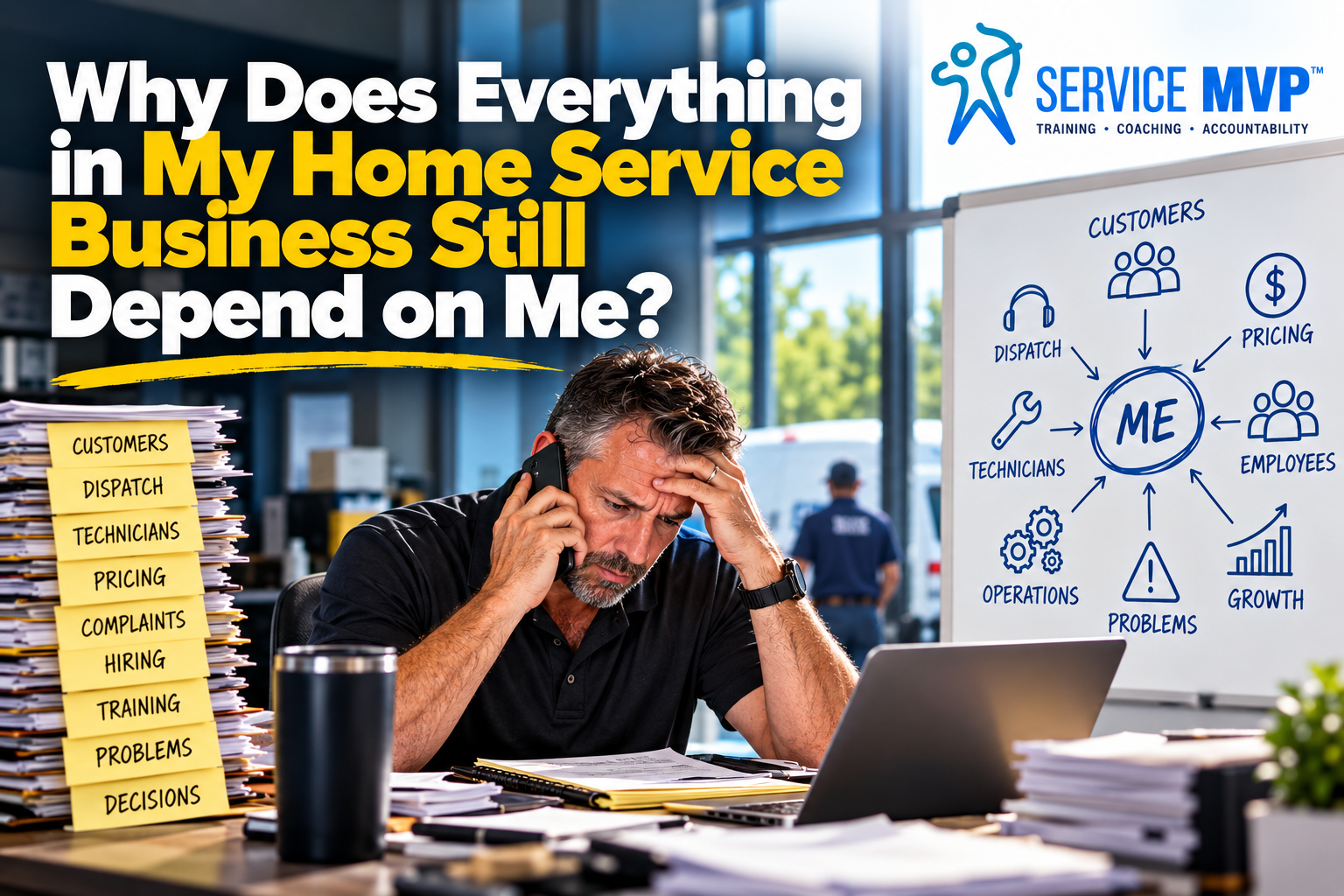
If your home service business can't run without you constantly answering questions, solving problems, approving decisions and putting out fires, you may own a company - but you've probably created another job for yourself. Building a real business means developing people, processes and accountability so the right things happen consistently, even when the owner isn't there. The goal isn't to make yourself unnecessary. It's to stop making yourself necessary for everything.
Being Busy Isn't the Same as Building a Business
I've met a lot of successful home service contractors who are exhausted.
The company has trucks.
Employees.
Customers.
Revenue.
Maybe even millions of dollars in annual sales.
From the outside, it certainly looks like a successful business.
But ask the owner to disappear for a week and everything changes.
Technicians start calling.
Dispatch has questions.
Somebody needs a price approved.
A customer is upset.
An employee doesn't know what to do.
A sales opportunity needs attention.
And suddenly the owner is running the company from a cell phone while supposedly on vacation.
That's when I ask a difficult question:
Do you own the business, or does the business own you?
Most Home Service Owners Didn't Start Out to Become Managers
This happens very naturally in the trades.
A great technician decides to go into business.
Maybe you're an excellent plumber, electrician or HVAC technician.
Customers like you.
You do good work.
You start getting referrals.
Eventually, there's more work than you can handle yourself, so you hire another technician.
Then another.
You buy another truck.
Then you need somebody answering phones.
Then somebody dispatching.
Revenue grows.
But something strange happens.
Instead of getting easier, your job gets harder.
You used to be responsible for doing the work.
Now you're responsible for everybody doing the work.
And nobody ever really taught you how to build the systems that make that possible.
The Owner Becomes the System
This is where many growing home service businesses get stuck.
There are processes in the company.
They're just stored in the owner's head.
The owner knows how a customer complaint should be handled.
The owner knows when a technician should call a manager.
The owner knows how much discounting is acceptable.
The owner knows what a CSR should say.
The owner knows what happens when a technician is running behind.
The owner knows how an estimate should be followed up.
Everybody else knows one thing:
Ask the owner.
That works when you're small.
As you grow, it becomes a bottleneck.
You can't build a scalable company around one person's availability.
If Everybody Needs Your Answer, You Haven't Built the Answer Yet
Owners sometimes tell me:
“Joe, my people just won't make decisions.”
Sometimes that's true.
But I also want the owner to look in the mirror.
Have you given them a process for making the decision?
If every unusual situation eventually gets escalated to you, your employees learn that the safest thing to do is wait for you.
Then you get frustrated because nobody takes ownership.
But we've accidentally trained them not to.
A system gives people a way to act without guessing.
It answers questions like:
What is the standard?
Who owns this decision?
What can this person do without approval?
When should something be escalated?
What happens next?
How do we know it was completed?
That's how you begin moving knowledge out of the owner's head and into the business.
Telling People What to Do Isn't a System
This is another trap.
You have a meeting.
You explain a new procedure.
Everybody nods.
You send an email.
Maybe you even write an SOP.
Three weeks later, nobody is doing it consistently.
And the owner says:
“We already went over this!”
You probably did.
But communicating a process once isn't the same as building a system.
If something matters enough to become a company standard, people need to understand it, train on it, practice it and be held accountable to it.
A document can tell someone what the process is.
Training helps them learn how to perform it.
Practice creates confidence.
Inspection tells you whether it's actually happening.
Accountability keeps it from becoming optional.
That's how a process becomes part of the company.
You Can't Delegate Chaos
Sometimes an owner realizes they're overwhelmed and decides:
“I need a manager.”
So they promote somebody.
Unfortunately, the new manager inherits all the same ambiguity the owner was dealing with.
There are no clear standards.
No defined decision-making authority.
No consistent coaching process.
No clear measurements.
Now instead of one overwhelmed person, there are two.
Delegation doesn't fix a broken system.
It simply gives the broken system to somebody else.
Before you ask someone to own an outcome, make sure you've given them a reasonable process for producing it.
Your Employees Shouldn't Have to Read Your Mind
This is especially important as your company grows.
The owner has years of experience that employees don't have.
You may look at a situation and immediately know what to do.
That doesn't mean the answer is obvious.
It means you've seen it before.
Your employee may be seeing it for the first time.
That's why one of the most important jobs of a leader is turning experience into teachable processes.
Instead of saying:
“You should have known.”
Ask:
“How would they have known?”
Was there a standard?
Was it taught?
Did they practice it?
Was it inspected?
Were they given feedback?
If the answer is no, you may not have a people problem yet.
You may have a system problem.
Systems Don't Replace Good People
Whenever I talk about systems, somebody worries that I'm suggesting businesses should become robotic.
I'm not.
Great people matter enormously.
But great people perform even better inside a great system.
Think about your best technician.
You don't want a system that prevents that person from using judgment.
You want a system that handles the predictable parts of the job so their judgment can be used where it actually matters.
The same is true for CSRs, dispatchers, managers and salespeople.
A good system doesn't eliminate thinking. It eliminates unnecessary guessing.
The Owner Has to Follow the System Too
This is the uncomfortable part.
You finally create a process.
You train everybody.
You establish accountability.
And then a situation comes up and the owner says:
“Forget the process. Just do what I'm telling you this time.”
Sometimes exceptions really are necessary.
But if the owner constantly bypasses the system, the team learns something very quickly:
It's not actually a system. It's a suggestion.
Your employees watch what you do much more carefully than they listen to what you say.
If you want the company to operate through systems, leadership has to respect those systems too.
Don't Build a Business That Requires a Hero
There's a strange badge of honor in entrepreneurship around being indispensable.
Nobody can handle that customer like I can.
Nobody understands the numbers like I do.
Nobody can train the technicians like I can.
Nobody can close that opportunity like I can.
It can feel good to be needed.
But there's a cost.
Every time the business requires you to rescue it, the company becomes more dependent on you.
And every rescue steals an opportunity to build somebody else's capability.
A healthy company shouldn't require a hero every day.
It should have people who know what they're responsible for, systems that support them and leaders who coach them when they need help.
Your Job Changes as the Business Grows
When you're starting a company, you do everything.
That's normal.
But eventually your job has to change.
You move from:
Doing the work
to
Teaching people how to do the work
to
Building systems that support the people doing the work
to
Developing leaders who can improve those systems and people without you.
That's a very different job.
And sometimes it's difficult for an owner to let go of the work they're already good at to learn the work the business now needs from them.
But that's where growth happens.
Here's a Simple Test
Imagine you couldn't answer your phone tomorrow.
Not forever.
Just one business day.
What would happen?
Would technicians know what to do when they encountered an unusual situation?
Could your CSRs handle customer concerns?
Would dispatch know how to prioritize the board?
Could a manager coach someone through a difficult service call?
Would your team know which decisions they could make without you?
Would customers receive approximately the same experience whether you were available or not?
Every place where the answer is no points to something worth examining.
Not because you should disappear from your company.
Because you should have the choice to.
The Goal Isn't to Remove the Owner
I don't believe the goal of building systems is to sit on a beach while everybody else works.
Most great entrepreneurs I know wouldn't enjoy that for very long anyway.
The goal is freedom to work on the things where you create the most value.
Creating opportunities.
Building relationships.
Improving the company.
Those are very different activities from answering the same question for the 47th time.
If you're constantly trapped in problems your company should already know how to solve, you don't have enough time for the work only you can do.
Build the Company Once
One of the biggest changes an owner can make is to stop solving the same problem repeatedly.
When something goes wrong, don't only ask:
“How do we fix this?”
Ask:
“How do we keep this from requiring me next time?”
Maybe the answer is training.
Maybe it's an SOP.
Maybe someone needs clearer authority.
Maybe the standard isn't clear.
Maybe the manager needs coaching.
Maybe the process simply doesn't work.
Solve today's problem.
Then build tomorrow's system.
That's how a business becomes less dependent on the owner one decision at a time.
Build Something Bigger Than Your Own Job
There's nothing wrong with being the best technician in your company.
There's nothing wrong with loving the work.
And there's nothing wrong with being deeply involved in your business.
But involvement and dependency are two different things.
Your company should benefit tremendously because you're there.
It shouldn't fall apart because you're not.
So if you find yourself answering the same questions, solving the same problems and rescuing the same situations week after week, don't immediately assume you need better employees.
Ask yourself:
Have I actually built the system they need to succeed without me?
Because the goal isn't simply to own a home service company.
It's to build a business.
Ready to Build a Business That Doesn't Depend on You for Everything?
At Service MVP, coaching isn't just about increasing sales.
We help home service owners and leaders build the training, coaching, accountability and business systems that allow their people to perform consistently - and allow the owner to lead instead of constantly putting out fires.
If your company is growing but everything still seems to come back to you, that may be the next problem worth solving.
EXPLORE SERVICE MVP COACHING
