
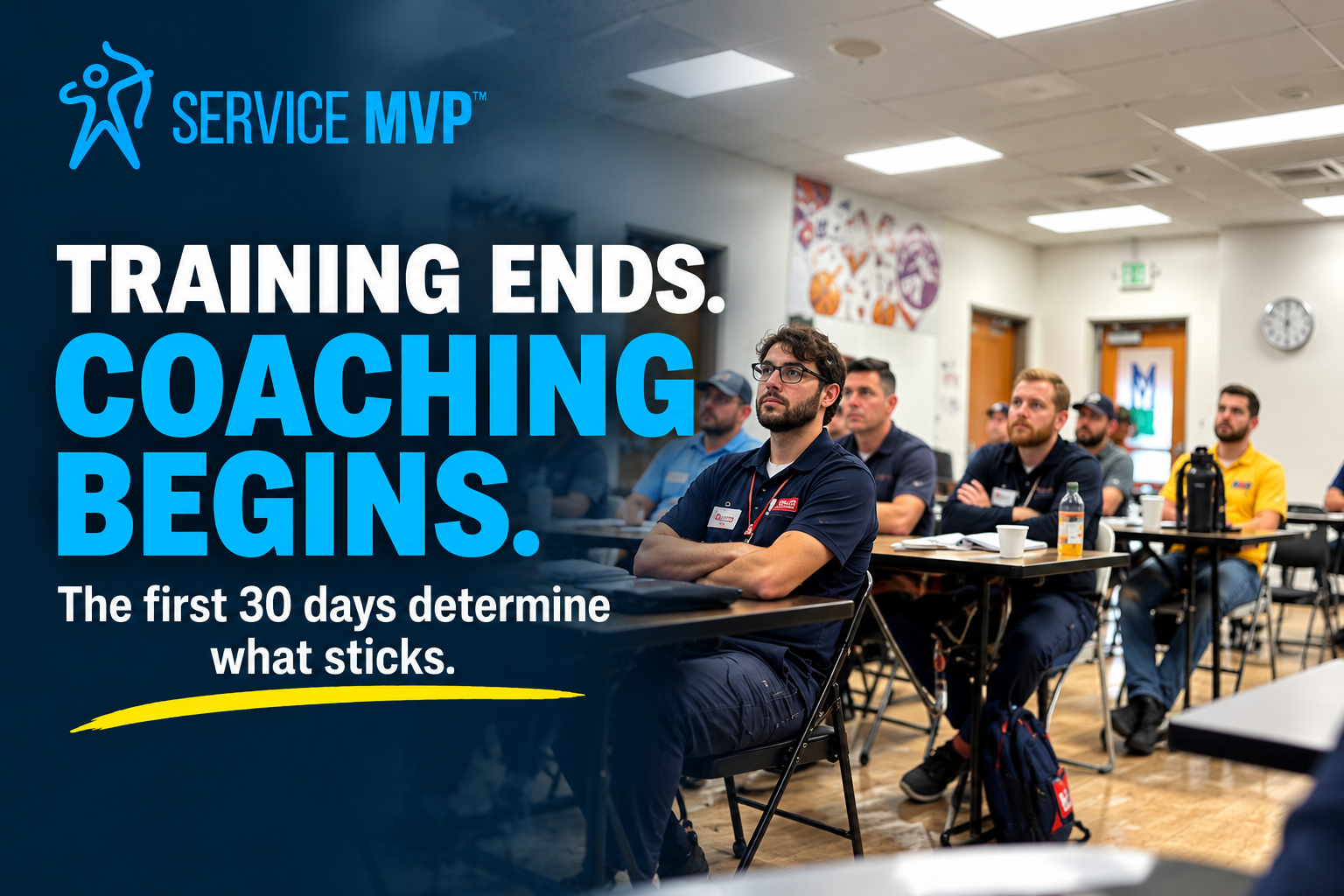
What Should Service Managers Do in the First 30 Days After Technician Training?
What Should Service Managers Do in the First 30 Days After Technician Training?
By Joe Crisara, Author of What Should We Do? and Co-Founder of Service MVP
You just invested in technician training.
Your team attended the class. They took notes. They practiced new conversations. They walked out excited about everything they learned.
And then Monday morning arrived.
The phones started ringing. The schedule filled up. Your technicians went back into customers' homes, and before long, many of them were doing things exactly the way they'd always done them.
Sound familiar?
Here's something I've learned after years of working with home service companies: The most important part of technician training often happens after the class is over.
If you're a service manager, your job isn't finished when your technicians complete their training. In many ways, that's when your job begins.
The first 30 days after training can determine whether your investment produces lasting improvements or becomes another forgotten event.
Let's talk about how to make those 30 days count.
Why Does Technician Training Wear Off So Quickly?
Think about the last training class your team attended.
Did everyone leave knowing what they were supposed to do differently?
Probably.
Did everyone immediately start doing it?
Maybe a few.
Were they still doing it consistently a month later?
That's where things usually get interesting.
The problem isn't necessarily that your technicians didn't understand the material.
It's that understanding something and being able to do it under pressure are two different skills.
A technician might know exactly how to explain repair options during a training exercise. But when a homeowner interrupts, questions the price, or seems impatient, that technician can quickly fall back into an old habit.
Why?
Because old habits are comfortable.
New behaviors require repetition, encouragement, and feedback before they become natural.
That's why successful service technician training must include a plan for what happens when technicians return to the field.
Days 1–7: Turn Training Into Daily Practice
The first week after training is critical.
Your technicians are returning with new information, but they haven't necessarily developed the confidence to use it consistently.
This is where service managers can make an immediate difference.
1. Focus on One Skill at a Time
One of the biggest mistakes managers make is expecting technicians to implement everything they learned immediately.
Imagine sending someone to a training class where they learn 15 new communication techniques.
On Monday morning, you tell them:
"Okay, I expect you to start doing all of that."
That's a pretty tall order.
Instead, choose one behavior that will make the biggest difference.
For example:
- Asking better questions before diagnosing the problem.
- Explaining the customer's options more clearly.
- Practicing how to respond when someone says, "That's too expensive."
- Presenting recommendations without making assumptions about what the customer can afford.
Choose one, and work on it until your team becomes more comfortable.
Small improvements that stick are more valuable than big changes that disappear.
2. Start Every Morning With Five Minutes of Practice
You don't need an hour-long meeting to reinforce training.
Sometimes five minutes is enough.
Before technicians leave for their first calls, ask one person to practice a common customer conversation.
You might say:
"Mike, I'm the homeowner. You just told me the repair will cost $1,200, and I say, 'That's way too expensive.' What do you say next?"
Let Mike respond.
Then ask the team what they liked about his answer and what could be improved.
Keep it constructive. Make it fun.
The objective isn't to embarrass anyone.
It's to help your technicians become more confident before they face the situation in a customer's home.
Remember, professional athletes don't wait until game day to practice.
Why should your technicians?
Days 8–14: Coach What Happens on Real Service Calls
During the second week, your focus should shift from practicing new skills to seeing how technicians use those skills in real situations.
This is where many companies lose momentum.
The training class is over, and the manager gets pulled back into scheduling problems, callbacks, customer complaints, and everything else that comes with running a service department.
Coaching gets pushed aside.
But if you're serious about improving technician performance, coaching can't be something you do only when there's a problem.
It needs to become part of how you manage.
3. Review Real Customer Conversations
When possible, listen to actual service calls or review what happened during customer interactions.
Pay attention to how technicians communicate, not just whether they made a sale.
Did the technician ask enough questions?
Did they explain the problem in language the homeowner could understand?
Did they offer appropriate solutions?
Did they give the customer an opportunity to make an informed decision?
Here's an important distinction.
You're not looking for reasons to catch technicians doing something wrong. You're looking for opportunities to help them get better.
If a technician handled a difficult conversation well, recognize it.
If something could have gone better, use it as a coaching opportunity.
And don't forget to ask the technician what they thought.
Sometimes they'll identify the problem before you do.
4. Ask Better Coaching Questions
Instead of saying:
"You should have handled that differently."
Try asking:
"What do you think went well on that call?"
Or:
"If you could have that conversation again, what would you do differently?"
These questions encourage technicians to think about their performance rather than simply waiting for the manager to tell them what to do.
That's how you begin developing people who can coach themselves.
And that's a pretty valuable skill.
Days 15–21: Build Accountability Without Micromanaging
By the third week, your technicians should be getting more comfortable with the behaviors they've been practicing.
Now it's time to establish some accountability.
But let's be clear about something.
Accountability doesn't mean standing over someone's shoulder all day.
It means creating clear expectations and following through.
5. Set Simple, Measurable Expectations
Suppose your team has been working on presenting multiple solutions to customers.
You could establish an expectation that technicians consistently explain the available repair or replacement options when appropriate.
Then review whether that's happening.
Not just whether the technician sold the most expensive option.
Not just whether the average ticket increased.
But whether the technician actually followed the process.
This matters because good processes tend to produce better results over time.
If you only measure revenue, you might miss the behaviors that created it.
And you might overlook technicians who are improving their skills but haven't yet seen the full financial impact.
6. Recognize Progress Publicly
People need to know when they're getting better.
If one of your technicians handles a difficult objection successfully, talk about it during your next team meeting.
You might say:
"Yesterday, Mike had a customer who was frustrated about the cost of a repair. Instead of getting defensive or immediately offering a discount, he asked a few more questions, explained the available options, and helped the homeowner make a decision."
That's a great example for the rest of the team.
And it reinforces the behavior you're trying to develop.
Recognition doesn't have to be complicated.
Sometimes a simple acknowledgment is enough to encourage someone to keep practicing.
Days 22–30: Measure Progress and Plan the Next 30 Days
By the fourth week, you should have enough information to begin evaluating what's working.
This is where your technician training investment starts becoming measurable.
But be careful about what you measure.
7. Don't Confuse Training Completion With Training Success
Just because a technician completed a course doesn't mean they've mastered the material.
The same goes for passing a quiz.
A technician might be able to identify the correct answer on a screen but struggle to use that same skill during a conversation with a homeowner.
That's why training completion should be the beginning of your evaluation, not the end.
Ask yourself:
- Are technicians consistently using the skills they learned?
- Are customer conversations improving?
- Are technicians becoming more confident?
- Are customers receiving clearer explanations and more complete options?
- Are we seeing improvements in customer satisfaction, close rates, or average tickets?
Look for patterns rather than judging everything based on one service call.
And remember that results can be affected by many factors, including call types, customer needs, and market conditions.
8. Create the Next Coaching Plan
At the end of 30 days, sit down with your team and review what you've accomplished.
Celebrate the improvements.
Identify the skills that still need work.
Then choose the next behavior to focus on.
This is how you create a culture of continuous improvement.
Instead of treating technician training as an annual event, you're making learning part of the everyday operation of your business.
And that's when things start to change.
The 30-Day Technician Training Follow-Up Plan
Here's a simple framework service managers can use after their next training event.
Timeframe. Manager's Focus. Primary Goal
Days 1–7 Daily practice and one priority skill Build confidence
Days 8–14 Review real customer interactions Reinforce application
Days 15–21 Establish expectations and recognize progress Create accountability
Days 22–30 Evaluate behavior and results Build lasting habits
You don't need a complicated system to get started.
You need consistency.
Five minutes of practice today.
A coaching conversation tomorrow.
A little recognition when someone improves.
And a manager who's committed to helping the team succeed.
That's how training begins to stick.
You Wouldn't Train Technical Skills This Way
Let me ask you something.
Would you send a brand-new HVAC technician to one class about diagnosing an electrical problem, hand them a certificate, and then assume they're ready to handle every electrical issue they'll ever encounter?
Of course not.
You'd expect them to practice.
You'd have someone experienced work with them.
You'd review their work and correct mistakes.
And you'd continue coaching them until they demonstrated they could perform the skill consistently.
So why do we sometimes treat communication and sales skills differently?
We send technicians to a class, teach them how to communicate with homeowners, and then expect them to perform perfectly without additional practice.
That doesn't make sense.
Communication is a skill. Helping customers make decisions is a skill. Explaining value is a skill.
And like every other skill, those abilities improve through practice, coaching, and repetition.
That's the mindset I want every service manager to develop.
Your Technicians Don't Need Another Training Event. They Need a Training Process.
Now, don't misunderstand me.
I believe in training.
I've dedicated a significant part of my career to helping home service professionals become better at communicating with customers and delivering value.
But I've also seen what happens when companies invest in training without having a plan to reinforce it.
The initial excitement fades.
Old habits return.
Managers get frustrated.
And owners start wondering whether the training was worth the money.
It doesn't have to be that way.
When you combine effective training with consistent coaching and accountability, you give your technicians a much better opportunity to turn new knowledge into lasting behavior.
And when that happens, everybody benefits.
Your technicians become more confident.
Your managers become more effective leaders.
Your customers receive a better service experience.
And your business has a stronger foundation for sustainable growth.
That's what we're really trying to accomplish.
Join Me for a FREE Live Webinar: How to Make Technician Training Stick
If you've ever invested in training only to watch your technicians return to their old habits, I want to help you change that.
On Thursday, October 22, 2026, at 5 PM Pacific / 8 PM Eastern, I'm hosting a FREE live webinar:
How to Make Technician Training Stick: Turn What Your Team Knows Into What They Actually Do
We'll explore why training doesn't always translate into better performance and what service managers can do to create lasting improvements.
You'll learn how to reinforce new skills, build a practical 30-day coaching plan, develop accountability without micromanaging, and measure whether your technicians are actually applying what they've learned.
Whether you're a home service business owner, service manager, or training leader, this session is designed to help you get more value from the training you've already invested in.
Reserve Your FREE Seat for the October 22 Webinar
I look forward to seeing you there.
— Uncle Joe
