
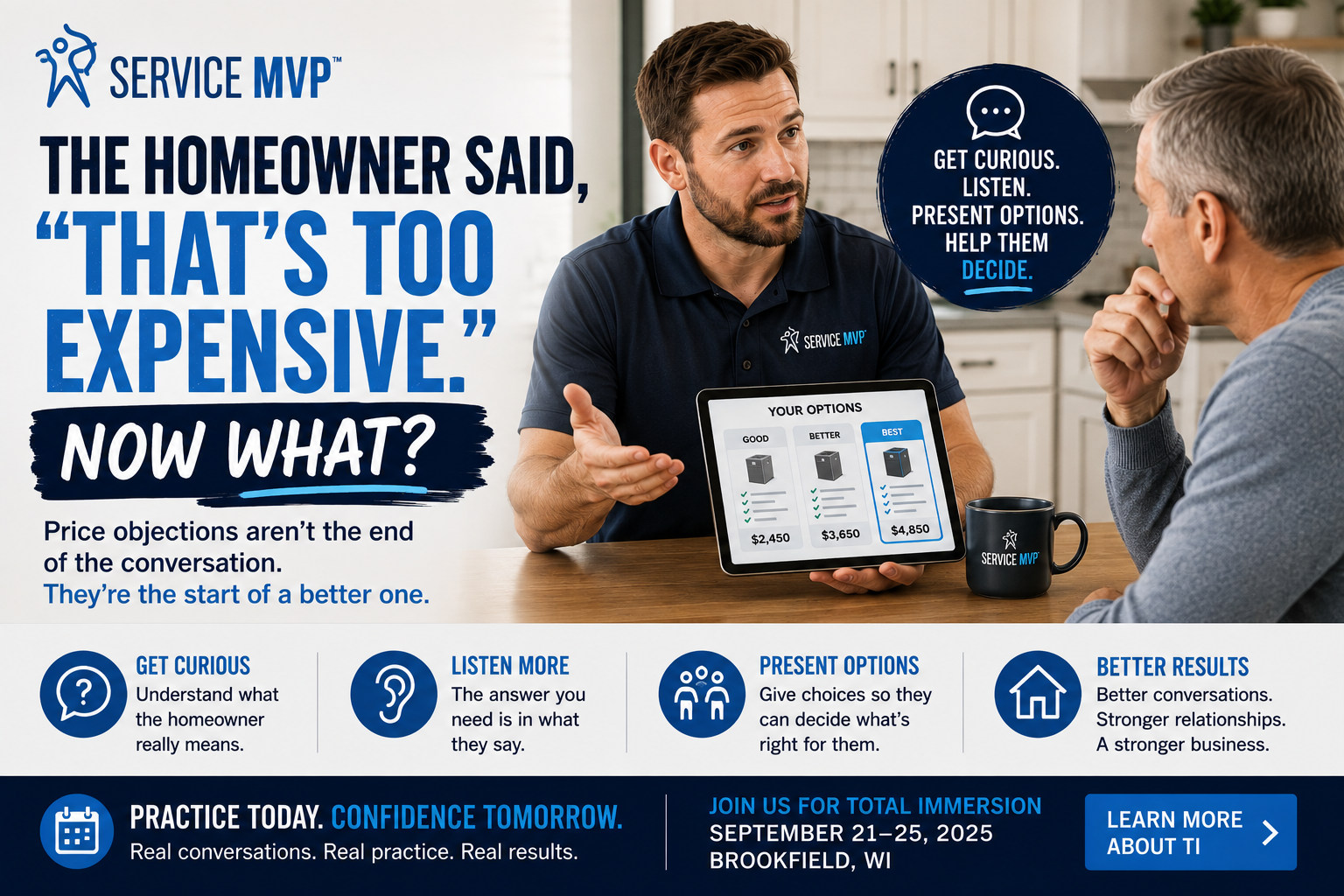
The Homeowner Said “That’s Too Expensive.” Now What?
The Homeowner Said “That’s Too Expensive.” Now What?
By Joe Crisara, Author of What Should We Do? and Co-Founder of Service MVP
Every service technician has heard it.
You investigate the problem.
You explain what you found.
You build appropriate options.
You present them to the homeowner.
They look at the prices and say:
“That’s too expensive.”
And suddenly, everything gets uncomfortable.
For a lot of technicians, this is the moment when the training disappears.
They start defending the price.
They offer a discount.
They talk about what other companies charge.
They explain how expensive trucks, insurance, parts, and labor have become.
Or they panic and start searching for something cheaper to offer.
But here's the first thing I want technicians to understand:
“That's too expensive” isn't necessarily a problem you need to overcome.
It's information.
Your job isn't to defeat the objection.
Your job is to understand it.
Stop Treating the Homeowner Like an Opponent
I don't like the idea that objection handling is a contest.
The homeowner says something.
The technician has a prepared response.
The homeowner pushes back.
The technician counters.
Eventually, somebody wins.
That's not the relationship we're trying to create.
The homeowner isn't your opponent.
They're the person you're there to serve.
So when they say:
“That's too expensive,”
instead of immediately thinking:
How do I overcome this?
try thinking:
I wonder what they mean by that?
That's a completely different mindset.
And it's where better conversations begin.
“Too Expensive” Can Mean a Lot of Different Things
Think about what the homeowner might actually be telling you.
They could mean:
“That's more than I expected.”
Or:
“I don't understand why it costs that much.”
Or:
“I don't see enough difference between these options.”
Or:
“I'm worried about spending this money right now.”
Or:
“I need to talk to my spouse.”
Or:
“I really can't afford that.”
Or maybe they simply don't believe the solution is worth the price.
Those aren't the same objection.
So why would we give every homeowner the same canned response?
Before we answer, we need to understand what they're actually telling us.
Get Curious Before You Get Defensive
One of the most powerful things a technician can learn is how to remain curious when a conversation becomes uncomfortable.
Instead of launching into an explanation, ask another question.
It might be as simple as:
“When you say it's too expensive, what were you expecting?”
Or:
“Is it the overall investment that's concerning you, or is there something about the options that doesn't make sense yet?”
Or even:
“Tell me a little more about that.”
The exact words aren't the important part.
The important part is the intention.
We're trying to understand—not argue.
And then comes the part technicians often struggle with most:
Be quiet and listen to the answer.
The homeowner will often tell you exactly what is preventing them from comfortably making a decision.
Don't Defend Your Price Before Anyone Attacks It
This connects directly to something we discussed in Your Pricebook Isn't the Problem If Technicians Can't Communicate the Value.
Technicians sometimes become uncomfortable with the price before the homeowner does.
They'll say:
“I know this is expensive…”
Or:
“Unfortunately, the price is…”
Or:
“I wish I could make it cheaper…”
Now we've communicated something to the homeowner:
Even the technician thinks this price is a problem.
If your company has done the work to calculate its costs, establish a profitable hourly rate, build appropriate pricing, train its people, stand behind its work, and deliver exceptional service, the technician doesn't need to apologize for that.
That doesn't mean being arrogant about the price.
It means being comfortable enough with it to present the options professionally and let the homeowner decide.
Sometimes a Price Objection Is Really a Value Problem
Imagine a homeowner calls because the air conditioner isn't cooling.
The technician arrives, diagnoses the problem, and five minutes later says:
“It'll be $1,850.”
What does the homeowner have to evaluate?
Mostly the number.
But imagine a different experience.
The technician listens to what's been happening.
They ask questions.
They investigate.
They uncover another issue the homeowner didn't realize was contributing to the problem.
They explain what they found.
They connect those findings to the homeowner's concerns.
They explain what could happen if nothing is done.
Then they present several appropriate ways to address the situation.
The price hasn't magically become irrelevant.
But now the homeowner has context.
That's why value isn't something you add at the end of a conversation.
It's built throughout the entire service experience.
More Talking Doesn't Necessarily Create More Value
This is another trap.
A homeowner says:
“That's too expensive.”
The technician gets nervous and starts talking.
And talking.
And talking.
They explain the company's history.
They explain the warranty.
They explain the truck.
They explain the part.
They explain their training.
They explain why everything costs more now.
Five minutes later, the homeowner is even less comfortable.
Communication isn't measured by how many words we use.
Sometimes the best response is a thoughtful question followed by silence.
Listen first. Explain second.
Don't Immediately Reach for a Discount
Discounting can become a reflex.
The homeowner pushes back.
The technician thinks:
I need to save this call.
So they lower the price.
That may solve the immediate discomfort, but it creates another problem.
What did we just teach the homeowner?
Possibly that the original price wasn't real.
And what did we teach the technician?
When someone becomes uncomfortable, abandon the pricing strategy.
There may be legitimate reasons for promotions, discounts, memberships, financing, or different solutions.
But those should be part of your company's intentional pricing strategy—not an emotional reaction to an uncomfortable conversation.
Before changing the price, understand the problem.
This Is Why Homeowners Need Choices
Suppose the homeowner only has one option.
$4,800.
Their decision is simple:
Yes or no.
If $4,800 doesn't feel right, the conversation is basically over.
But if the technician has created several legitimate solutions based on what they found, the conversation can be very different.
Perhaps there's a comprehensive solution.
A mid-range solution.
A more economical repair.
Maybe there are differences in longevity, protection, efficiency, convenience, warranties, or scope.
Now the homeowner isn't necessarily deciding:
“Do I spend $4,800?”
They're deciding:
“Which solution makes the most sense for me?”
That's why we teach technicians to present multiple appropriate options rather than forcing homeowners into one take-it-or-leave-it price.
We explore that further in Stop Giving Homeowners One Price: Why Service Technicians Should Present Options.
But Options Aren't a Trick
This is important.
We're not creating three options because we secretly want the homeowner to pick the middle one.
We're not intentionally making one option ridiculous so another looks attractive.
And we're not building choices designed to manipulate someone toward the most expensive solution.
That's not Pure Motive.
The options should represent real, appropriate ways to address what we've discovered.
Then we explain the differences clearly.
And the homeowner chooses.
Sometimes they'll choose the most comprehensive option.
Sometimes the least expensive.
Sometimes nothing.
Their decision belongs to them.
What If They Really Can't Afford It?
Then they can't afford it.
That's an important answer too.
Our job isn't to turn every no into a yes.
If we've listened, investigated, communicated clearly, created appropriate choices, and genuinely understood the homeowner's concern, there may still be situations where they simply cannot or do not want to move forward.
That's okay.
We don't have to pressure them.
We don't have to make them uncomfortable.
And we don't have to turn a service relationship into a confrontation.
We can leave the homeowner informed, respected, and in control.
That's still a successful service experience.
The Technician's Job Isn't to Close Everyone
Traditional sales training often focuses heavily on closing.
At Service MVP, I want technicians focused on something different:
Helping the homeowner make a confident decision.
Those sound similar, but they're not.
One focuses on the outcome we want.
The other focuses on the outcome the homeowner needs.
Our technician's job is to:
Listen.
Investigate.
Understand.
Educate.
Create appropriate choices.
Answer questions.
And let the homeowner decide.
When we do those things well, revenue often follows.
But revenue is the result of serving the customer properly—not the reason we abandon our values.
This Is Exactly Why Technicians Need to Practice
In our previous article, Why Knowing What to Say Isn't Enough: Your Technicians Need to Practice It, we talked about the difference between knowing a communication process and actually being able to use it.
“That's too expensive” is the perfect example.
Reading this article is easy.
Remaining calm when a real homeowner says it is different.
That's where role-play becomes valuable.
Have one person play the homeowner.
Have the technician present the options.
Then have the homeowner say:
“Whoa. That's way more than I thought this would cost.”
What happens next?
Does the technician immediately defend the price?
Do they start talking too much?
Do they discount?
Do they get visibly uncomfortable?
Or do they slow down, become curious, ask a thoughtful question, and listen?
Now stop.
Coach it.
Try again.
Change the homeowner's response.
Try again.
Repeat it until the technician isn't searching for the correct line anymore.
They're actually having the conversation.
Objections Aren't Something to Fear
When technicians are afraid of objections, they'll often unconsciously try to avoid them.
They rush through pricing.
They don't present certain options.
They prejudge customers.
They discount.
They talk too much.
Or they avoid asking questions that might lead to uncomfortable conversations.
But once they've practiced those moments repeatedly, something changes.
The objection stops feeling like an emergency.
It's just another part of the conversation.
And that creates confidence.
Not because the technician learned a magic rebuttal.
Because they've learned how to listen.
Don't Overcome the Objection. Understand It.
The next time a homeowner says:
“That's too expensive,”
remember:
You don't know what that means yet.
So don't defend.
Don't argue.
Don't panic.
Don't immediately discount.
Get curious.
Ask.
Listen.
Understand.
Then help the homeowner evaluate their choices.
Because the goal isn't to overcome the homeowner.
The goal is to help them make the decision that's right for them.
Want Your Technicians to Practice These Conversations Before They Happen?
Knowing how to handle a pricing conversation is one thing.
Being able to calmly navigate it when a homeowner is looking directly at you is another.
That's why objection handling, homeowner communication, role-play, feedback, and repetition are part of
the skills we develop through Service MVP training.
Our next Total Immersion takes place September 21–25 in Brookfield, Wisconsin, hosted at Quality Heating, Cooling, Plumbing & Electrical.
Instead of waiting for the customer's home to become the practice field, give your technicians somewhere safe to practice first.
