By Joe Crisara, America's Service Sales Coach and Author of What Should We Do?
Short answer
How do you build six HVAC replacement options?
At Service MVP, we teach contractors to build six HVAC equipment replacement options: two premium, two mid-range, and two economy. One of the easiest ways to learn option building is to build from the bottom up, then present from the top down.
When a homeowner needs a new heating and cooling system, what does your technician or comfort advisor typically present?
A 14 SEER system, a 16 SEER system, and a higher-efficiency model?
Maybe you offer three different brands. Or perhaps you present one equipment package with a few upgrades the homeowner can add.
Here's the problem: You're asking the homeowner to choose equipment when what they really want is a solution.
They don't wake up thinking about compressors, air handlers, or efficiency ratings.
They want their bedrooms to be comfortable. They want dependable heating and cooling. They want cleaner air, fewer unexpected breakdowns, and confidence that the money they're spending will solve their problems.
And those priorities aren't the same for every homeowner.
That's why, at Service MVP, we teach contractors to build six HVAC equipment replacement options: two premium, two mid-range, and two economy.
Not six prices for the same equipment.
Six meaningful choices that allow homeowners to decide what level of comfort, quality, reliability, protection, and service is right for their family.
Let's walk through how to build them.
Why Three HVAC Replacement Estimates Aren't Enough
Most HVAC contractors are familiar with the good-better-best approach.
It's certainly better than presenting one price and hoping the homeowner accepts it.
But there's a limitation.
When you offer only one premium option, one mid-range option, and one economy option, the homeowner must decide whether they want that particular package.
What happens when they like the premium equipment but don't want every accessory?
What if they want better air distribution but aren't interested in the highest-efficiency system?
What if they want a longer warranty and more service, but their budget doesn't support your most comprehensive package?
With only three choices, those homeowners may feel they have to compromise.
Six options give homeowners two choices within each level of investment.
They can compare two premium solutions, two mid-range solutions, or two economy solutions without having to reject an entire category.
The goal isn't to confuse people with more prices.
It's to give them more meaningful ways to solve their problems.
First, Understand What the Homeowner Is Actually Buying
Before you build a single equipment option, you need to understand why the homeowner wants a new system.
In our Service MVP training, I teach technicians and comfort advisors to discover seven things before presenting solutions:
- Why? What's the real reason they're considering replacement?
- Why now? What changed that made this a priority?
- Who? Who is affected by the problem and involved in the decision?
- Who else? Who might influence their decision?
- When? When do they want the work completed?
- What? What do they believe they need?
- What else? What important problems or opportunities haven't they considered?
These questions matter because the homeowner's initial request rarely tells the whole story.
Someone might say, "Our air conditioner is getting old."
But age alone doesn't explain why they called today.
Maybe the upstairs bedrooms haven't been comfortable for years.
Maybe their electric bills are becoming difficult to manage.
Maybe they've experienced several breakdowns and no longer trust the system.
Or maybe they're concerned about indoor air quality.
Until you understand those priorities, you don't know which equipment improvements will actually create value.
The best HVAC replacement proposal isn't the one with the most expensive equipment. It's the one that addresses what matters most to the homeowner.
Don't Confuse an Equipment Replacement With a Complete Comfort Solution
Here's something I want every HVAC contractor to understand.
Replacing the outdoor unit and air handler doesn't automatically mean you've solved the homeowner's comfort problems.
What if the return ductwork is undersized?
What if the air distribution system has significant leakage?
What if certain rooms receive inadequate airflow?
What if the homeowner's concerns involve filtration, temperature control, or long-term maintenance?
A new piece of equipment may be part of the solution, but it isn't necessarily the entire solution.
That's why our equipment replacement options consider the complete system.
Depending on the home's actual conditions, that may include:
- Heat pump and air handler selection
- Return and supply duct improvements
- Air distribution sealing
- Filtration and indoor air quality enhancements
- Temperature controls
- Warranty coverage
- Planned maintenance and service
Not every home needs every improvement.
And every option must be properly designed, compatible with the equipment, compliant with applicable codes, and appropriate for the homeowner's needs.
But when you inspect the complete system, you can create solutions that are genuinely different—not simply different equipment prices.
How to Build Six HVAC Equipment Replacement Options
One of the easiest ways to learn option building is to build from the bottom up, then present from the top down.
Start with the most economical complete replacement solution.
Then progressively add meaningful improvements in quality, reliability, comfort, air distribution, service, and protection.
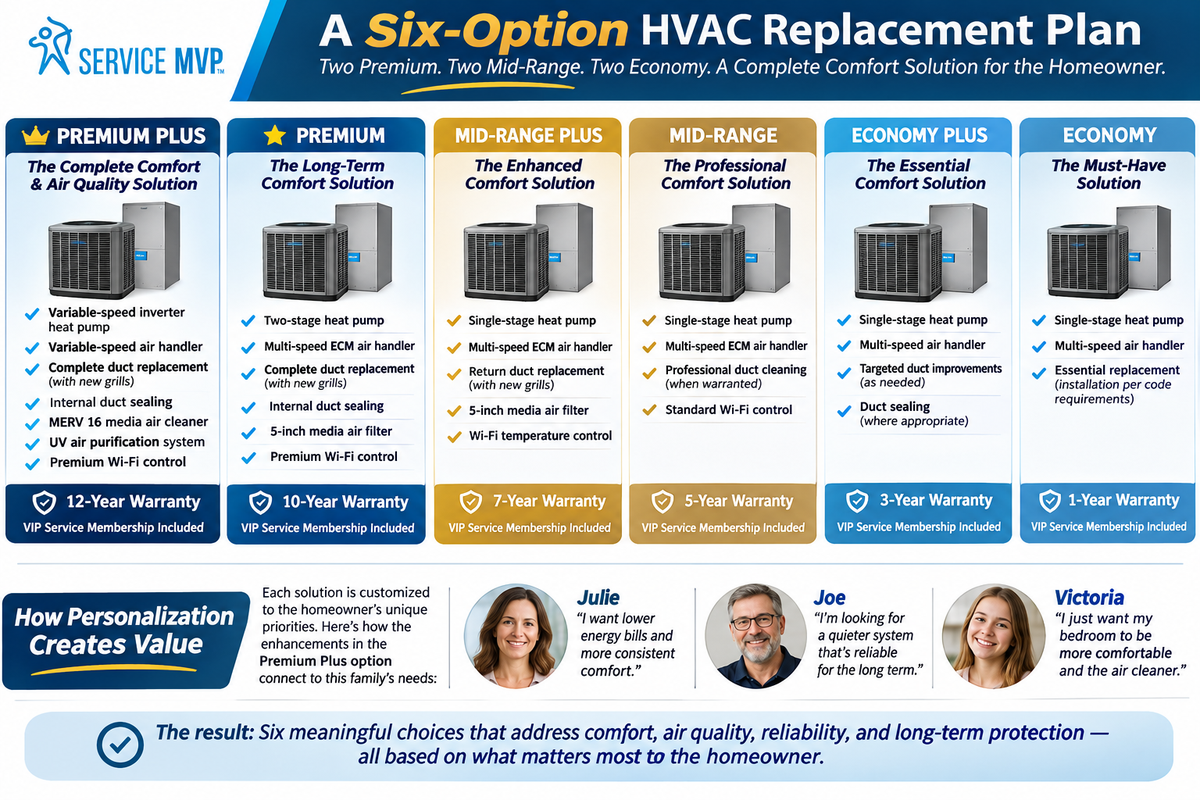
Let's use a four-ton heat pump replacement as an example, based on an equipment template I use when teaching option building.
The specific equipment and enhancements are examples, not universal requirements. Your final scope should always be based on proper system evaluation and design.
Option 6: Economy - The Must-Have Solution
This is the foundation.
The economy option provides a properly designed, code-compliant equipment replacement without adding improvements the homeowner doesn't need or hasn't chosen.
In our example, the package includes:
- Single-stage heat pump
- Matching multi-speed ECM air handler
- Required installation materials and work
- Basic warranty and service provisions
This option is for homeowners who want a functional, economical equipment replacement.
It's not an inferior installation.
Economy should never mean cutting corners on safety, workmanship, or code compliance.
It simply means providing the essential solution with fewer enhancements.
Option 5: Economy Plus - The Essential Comfort Solution
Now we begin adding value.
In Joe's example template, the next economy level introduces selected air distribution improvements and additional protection.
Depending on the home's condition, these might include:
- The essential heat pump and air handler replacement
- Targeted ductwork improvements
- Basic duct sealing where appropriate
- Enhanced warranty coverage
- Included service membership
The difference between the two economy options should be something the homeowner can understand.
One addresses the essential equipment replacement.
The other adds improvements that support the performance and reliability of that replacement.
Option 4: Mid-Range - The Professional Comfort Solution
Now we're moving beyond the basic equipment replacement.
In our sample, this level includes:
- Single-stage heat pump
- Matching multi-speed ECM air handler
- Professional duct cleaning, when warranted
- Standard Wi-Fi temperature control
- Expanded warranty coverage
- VIP service membership
The homeowner isn't simply buying new equipment.
They're investing in additional attention to the system that distributes and controls their heating and cooling.
This is where the conversation should shift from equipment specifications to everyday benefits.
What will the homeowner notice?
What problems are we addressing?
Why were these improvements included?
If you can't explain those answers clearly, the option probably needs more work.
Option 3: Mid-Range Plus - The Enhanced Comfort Solution
The next mid-range option adds more significant system improvements.
Our sample includes:
- Single-stage heat pump
- Matching multi-speed ECM air handler
- Return duct system replacement
- Enhanced media filtration
- Wi-Fi temperature control
- Longer warranty coverage
- VIP service membership
Notice what's happening.
We're not simply adding a more expensive thermostat to increase the price.
We're addressing additional parts of the comfort system.
For a homeowner who has experienced uneven temperatures or airflow concerns, properly designed return duct improvements may be more relevant than purchasing a higher-efficiency outdoor unit alone.
The value comes from solving the homeowner's actual problems.
Option 2: Premium - The Long-Term Comfort Solution
Now we begin building a more comprehensive equipment and air distribution solution.
In our sample, this option includes:
- Two-stage heat pump
- Matching multi-speed ECM air handler
- Complete return and supply duct replacement
- Internal air distribution sealing
- Enhanced media filtration
- Premium Wi-Fi temperature control
- Extended warranty coverage
- VIP service membership
This option addresses more than the heating and cooling equipment.
It considers how conditioned air moves through the home, how the homeowner controls comfort, and how the system will be supported over time.
A homeowner who prioritizes dependable comfort and long-term protection may see substantial value in that approach.
But we still have one more option.
Option 1: Premium Plus - The Personalized Whole-System Solution
This is the most comprehensive option.
In our training example, it includes:
- High-efficiency variable-speed inverter heat pump
- Matching variable-speed air handler
- Complete return and supply duct replacement
- Internal duct sealing
- MERV 16 media filtration, where compatible with the system design
- UV air purification equipment
- Premium Wi-Fi temperature control
- Extended warranty coverage
- VIP service membership
This is where we bring together the homeowner's priorities and the most complete solution we can responsibly provide.
But there's one more important element.
Personalization.
If the homeowner told you that the upstairs bedrooms have been uncomfortable for years, your presentation should explain how the proposed system design addresses that concern.
If they expressed concern about indoor air quality, explain the filtration and other appropriate enhancements, including their capabilities and limitations.
If they're worried about breakdowns, explain the equipment, warranty, and planned service provisions.
The homeowner should recognize their own concerns in the solution.
That's what makes the premium option relevant instead of simply expensive.
A Sample Six-Option HVAC Replacement Comparison
Here's how the six levels fit together.
| Level | Equipment and system focus | Example protection |
| Premium Plus | Variable-speed system, complete duct replacement, advanced filtration, UV equipment, premium controls | 12-year warranty |
| Premium | Two-stage system, complete duct replacement, enhanced filtration, premium controls | 10-year warranty |
| Mid-Range Plus | Single-stage system, return duct replacement, enhanced filtration | 7-year warranty |
| Mid-Range | Single-stage system, selected duct improvements and Wi-Fi controls | 5-year warranty |
| Economy Plus | Essential equipment replacement with targeted distribution improvements | 3-year warranty |
| Economy | Essential heat pump and air handler replacement | 1-year warranty |
Illustrative example adapted from a Service MVP training template in OptionBuilder AI. Warranty terms, equipment, installation scope, and service coverage vary by contractor, manufacturer, and project. All six example levels include a VIP Service Membership.
The purpose of this comparison isn't to tell you exactly which equipment to install.
It's to show how each level offers a different scope of service and long-term value.
And here's an important distinction: If an existing duct system is unsuitable for the new equipment, the necessary corrective work isn't an optional luxury. Every proposed package must meet the home's technical requirements.
Why You Should Build From Economy to Premium but Present Premium First
When you're learning to create options, building from the bottom up makes the process easier.
You begin with the essential solution.
Then you ask:
What would improve the reliability of this installation?
What could improve comfort?
What other verified system problems should we address?
What additional service or warranty protection can we responsibly provide?
Each step builds on the previous one.
But when it's time to present the options to the homeowner, start with the most comprehensive solution first.
Why?
Because the homeowner deserves to understand the full range of possibilities before deciding what level of investment is appropriate.
If you start with the cheapest equipment package, the conversation can quickly become focused entirely on price.
When you explain the complete solution first, you have the opportunity to discuss comfort, air distribution, quality, reliability, and service before revealing the investment.
Then the homeowner can compare that solution with the other choices.
You're not telling them what they must buy.
You're giving them enough information to make their own decision.
Don't Present Six Equipment Options Before You've Earned the Opportunity
There's another lesson I teach that's especially important for service technicians.
If you were called to repair a system, don't automatically turn that call into an equipment replacement presentation.
Start by diagnosing the problem and providing appropriate repair options.
A homeowner who called because their air conditioner stopped cooling didn't necessarily invite you to sell them a complete replacement system.
But sometimes, after reviewing the repair options, they'll ask:
"How much would a new one cost?"
That's an opportunity to explore replacement.
Now you can ask questions, evaluate the system, and determine whether a replacement presentation is appropriate.
If the homeowner called specifically for equipment replacement, the conversation begins differently. Your responsibility is to understand why they want to replace it and what they hope to accomplish.
In either case, the goal is the same.
Let the homeowner's needs guide the solution - not the technician's desire to sell equipment.
How to Explain Premium HVAC Options Without Sounding Pushy
Here's where a good equipment replacement proposal becomes a great one.
Most HVAC technicians know how to explain what they're installing.
They can describe a variable-speed heat pump, a new air handler, upgraded ductwork, or an advanced filtration system.
But there's a difference between explaining what equipment does and explaining why you've included it for this particular homeowner.
At Service MVP, we teach technicians to connect each part of the solution to the homeowner's personal concerns, priorities, and desired outcome.
Let's look at an example from an actual equipment option-building exercise using OptionBuilder AI.
One Family, Several Different Priorities
Imagine you're building a replacement proposal for Julie, Joe, and Victoria.
During your conversation, you discover that each family member has different concerns.
Julie wants more consistent comfort and lower utility bills.
Joe wants a quieter, more dependable system.
Victoria wants her bedroom to be comfortable.
The family also values cleaner indoor air and convenient temperature control.
Now think about what a traditional equipment proposal might look like.
You could list the heat pump, air handler, ductwork, filtration, and thermostat with a price at the bottom.
Technically, you've explained what's included.
But you haven't explained why those improvements matter to this family.
That's where personalization changes the presentation.
Connect Every Improvement to a Homeowner's Concern
In Joe's Platinum Plus equipment replacement example, the individual tasks are connected to specific priorities:
| Equipment or improvement | How the solution is personalized |
| Variable-speed inverter heat pump | Included because Julie wants lower bills and steadier comfort. |
| Variable-speed air handler | Included because Joe wants quieter airflow and better reliability. |
| Complete return and supply duct replacement | Included because Victoria needs more balanced comfort throughout the home. |
| Internal duct sealing | Included because Julie wants to reduce air leakage and improve efficiency. |
| MERV 16 media air cleaner | Included because Joe values cleaner air and better filtration. |
| UV air purification system | Included because Victoria's indoor air quality is a family priority. |
| Premium Wi-Fi temperature control | Included because Julie wants easier control and convenience. |
These are examples of how the proposal connects tasks to homeowner priorities. Actual equipment selection and expected results must be supported by the home's system evaluation and proper design.
Notice what's happening.
We're not just describing features.
We're giving the homeowner a reason to care about each one.
And those reasons came from the homeowner—not from the technician's sales pitch.
Use the Word “Because” to Explain Your Recommendations
One of the simplest ways to improve an equipment presentation is to explain why each improvement was selected.
For example:
"Julie, I included the variable-speed heat pump because you told me that maintaining consistent temperatures and managing your energy bills are important to you."
"Joe, I included the variable-speed air handler because you mentioned that quieter operation and reliability are priorities."
"And I included the ductwork improvements because you told me Victoria's bedroom hasn't been as comfortable as the rest of the house."
See the difference?
Instead of saying, "This is our best system," you're explaining how the proposed solution addresses the family's concerns.
The word “because” connects the work you're recommending to the reason the homeowner might want it.
That's how you create relevance without relying on pressure.
Personalize the Solution Title, Too
The personalization shouldn't stop with individual tasks.
Your premium option can also have a title that reflects the homeowner's desired outcome.
Instead of simply calling it:
Platinum Plus Equipment Replacement
You might call it:
Platinum Plus - The Family's Complete Comfort and Peace-of-Mind Solution
The title should reflect what you learned during the conversation.
If the homeowner is concerned about reliability, emphasize dependable comfort.
If they're concerned about uneven temperatures, emphasize whole-home comfort.
If they want fewer maintenance surprises, emphasize long-term service and protection.
But don't invent concerns just to make the proposal sound more personal.
The strongest presentation uses the homeowner's own priorities.
Personalization Doesn't Mean Promising Results You Can't Deliver
There's one important distinction.
Connecting an improvement to a homeowner's concern doesn't mean guaranteeing that the equipment will solve every problem.
For example, if the homeowner wants lower energy bills, you can explain why you're recommending a more efficient system. But you shouldn't promise a specific savings amount without a supported calculation.
If a family is concerned about indoor air quality, explain the intended purpose and limitations of filtration or UV equipment. Don't promise to prevent illness.
And if a bedroom has uneven temperatures, verify the underlying airflow and system-design issues before promising that duct replacement will correct them.
Personalization makes a solution relevant. Proper diagnosis and system design make it credible.
You need both.
The Goal Is Recognition, Not Persuasion
When homeowners review their options, they should recognize the concerns they shared with you.
They should be able to say:
"That's the problem we talked about."
"That's why we wanted someone to look at the ductwork."
"That's the improvement we were hoping for."
That's when an equipment proposal becomes more than a list of products and prices.
It becomes a personalized plan for the homeowner's comfort, reliability, and long-term service needs.
And when you give them six meaningful choices, they can decide how much of that plan they want to invest in.
That's Pure Motive Service: helping people make informed decisions based on what matters to them - not simply selling them the most expensive equipment.
Make Warranties and Service Part of the Conversation
One of the most overlooked opportunities in equipment replacement is long-term service.
Homeowners aren't simply purchasing equipment for installation day.
They're making an investment they expect to depend on for years.
Joe's six-option equipment template illustrates different warranty levels, from one year in the economy package to twelve years in the premium-plus package.
It also includes a VIP Service Membership with every option.
The lesson isn't that every contractor should promise twelve years of coverage.
It's that warranty terms, maintenance, and ongoing service should be clearly explained as part of the value of each solution.
Homeowners need to understand what's covered, what's excluded, what maintenance is required, and what responsibilities they retain.
Those details can be just as important to their decision as the equipment itself.
How OptionBuilder AI Helps Technicians Create Six Equipment Options
One reason technicians struggle with equipment options is that building six complete proposals takes time.
They have to account for equipment, accessories, installation work, system improvements, warranties, service, and pricing.
And every proposal needs to be relevant to the particular homeowner.
That's where OptionBuilder AI can help.
Instead of starting with a blank sheet on every call, contractors can use templates to organize and customize their solutions.
A technician can begin with an equipment replacement template, review the home's actual conditions, and tailor the proposed options to the homeowner's needs.
The technology helps organize the presentation.
But it doesn't replace the technician's responsibility to diagnose the system, design appropriate solutions, and communicate clearly.
The goal is to make good option building repeatable - not to automate away good judgment.
Train Your Team to Build Options Before Expecting Them to Present Options
Here's where many contractors make a mistake.
They introduce a new proposal format, show their technicians a six-option sheet, and expect everyone to start using it successfully.
But building options is a skill.
And presenting them is another skill.
Your technicians need to practice both.
Start with a common equipment replacement scenario.
Have your team build the essential economy option first.
Then challenge them to create five additional choices with meaningful differences.
Ask them to explain why each improvement was included.
Have them practice presenting the premium option in plain language.
Then role-play homeowner questions about price, comfort, warranties, and the differences between the packages.
Finally, review the options together.
Are they technically appropriate?
Are the differences clear?
Do they address the homeowner's concerns?
Would the homeowner understand what they're buying?
At Service MVP, we teach contractors to develop these skills through training, practice, coaching, and accountability.
Because knowing that you should offer six options isn't the same as knowing how to build and present them.
The Bottom Line: Stop Selling Equipment and Start Offering Solutions
A homeowner doesn't need six different prices for a heat pump.
They need to understand their choices.
They need to know what problems each solution addresses, what improvements are included, and what level of long-term service and protection they're receiving.
That's the difference between selling equipment and providing a complete service experience.
Two premium options.
Two mid-range options.
Two economy options.
Six opportunities to serve the homeowner at the level that's right for them.
And when you've explained the choices clearly, there's one question left to ask:
What should we do?
Ready to Help Your Team Build Better Equipment Options?
Service MVP helps HVAC, plumbing, and electrical contractors develop the communication, option-building, and presentation skills needed to serve homeowners more effectively.
And with OptionBuilder AI, your team can organize customized equipment and service solutions using reusable templates.
Give your technicians the training and tools to offer meaningful choices - not just another estimate.
