
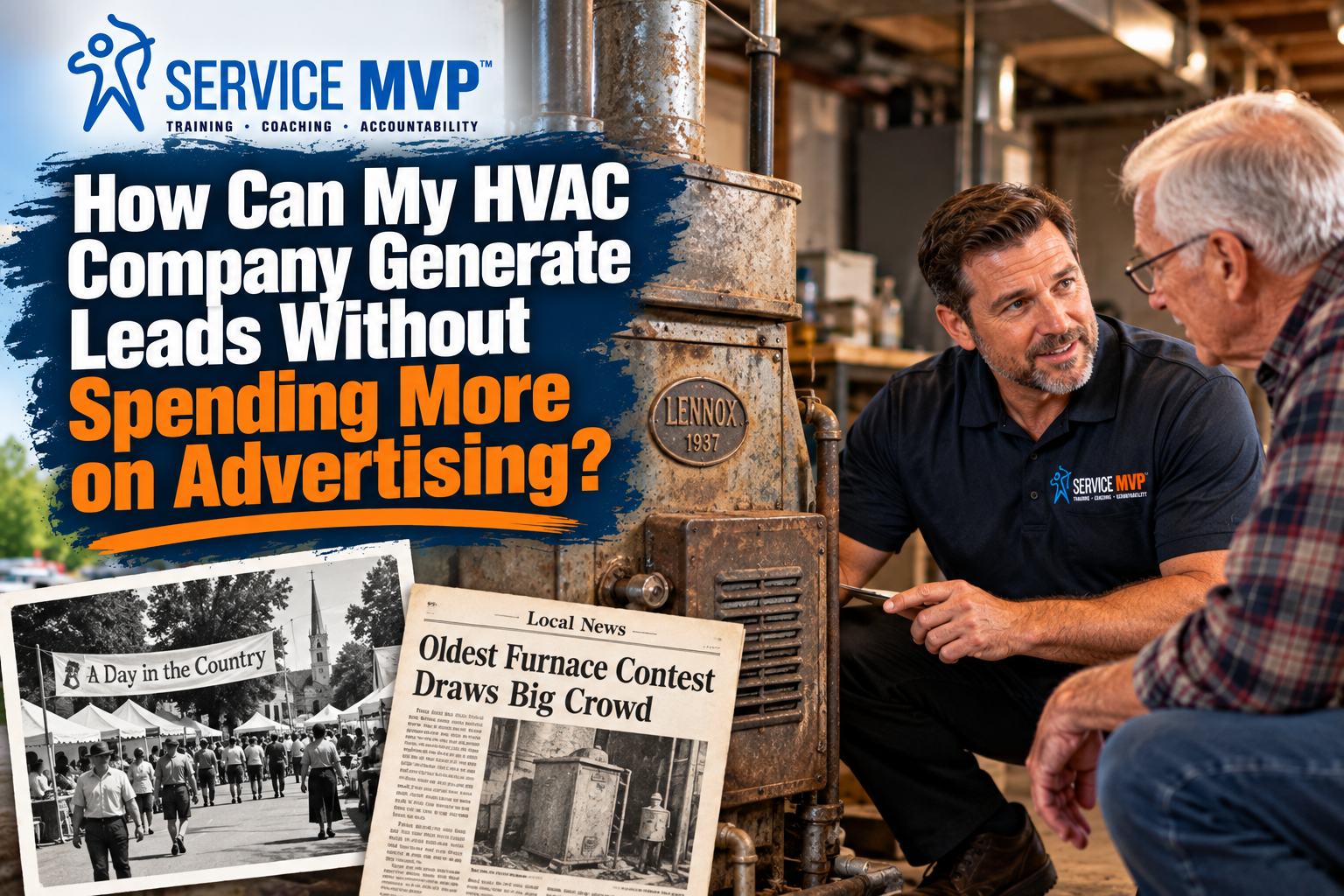
How Can My HVAC Company Generate Leads Without Spending More on Advertising?
How Can My HVAC Company Generate Leads Without Spending More on Advertising?
By Joe Crisara, Author of What Should We Do? and Co-Founder of Service MVP
If you want to generate more HVAC leads without continually increasing your advertising budget, give your community a reason to talk about your company. A creative promotion, local event, partnership or story can create attention that another coupon or paid ad may not. The key is to make the promotion genuinely interesting or valuable to the community - not simply disguise an advertisement as an event.
The answer became one of my favorite marketing experiments we've ever done. We called it the Oldest Furnace Contest. In fact, the campaign attracted enough attention at the time that ACHR News covered the contest while it was happening in 2003.
What started as an idea to find the oldest operating furnace in the area generated phone calls, equipment opportunities, tune-ups, hundreds of event attendees and extensive local media coverage. The tools we used in 2003 have changed. The principle hasn't.
Before Social Media, We Had to Find Another Way to Get Attention
Back in 2003, I was working with Rosenthal Heating & Air Conditioning in Wisconsin.
There was no Facebook advertising.
No Instagram.
No TikTok.
No Google Local Services Ads.
If a contractor wanted more business, the usual answer was pretty predictable:
Buy more advertising.
But I've never been particularly interested in doing something just because everybody else is doing it.
So we started asking a different question:
How could we get the community to talk about the company without simply buying more ads?
The answer became one of my favorite marketing experiments we've ever done.
We called it:
The Oldest Furnace Contest
The idea was simple.
We would find the oldest operating residential furnace or boiler in the area.
The homeowner with the oldest qualifying system would receive a brand-new high-efficiency furnace, installed free.
But the contest itself wasn't really the genius of the campaign.
The system we built around it was.
Don't Just Create a Promotion. Create a Story.
This is probably the biggest lesson I would want a contractor to take from what happened next.
We could have run an advertisement that said:
OLD FURNACE? CALL US TODAY!
Nobody would have cared.
Instead, we connected the contest to Rochester, Wisconsin's annual “A Day in the Country” community heritage event.
That changed everything.
As I wrote later in Finding Gold in Something Old, the contest became more than a promotion. It became a mission to find the oldest furnace in the county.
People got into it.
At a local diner, we overheard a group of men debating which local resident had the oldest furnace.
People actually came into the shop convinced that their furnace was going to win.
Think about that.
We weren't trying to interrupt people long enough to show them an advertisement.
People were talking about the promotion when we weren't even in the room.
That's marketing.
We Didn't Try to Make Rosenthal the Story
This is where contractors sometimes get local marketing wrong.
Every story becomes:
“Look at us!”
“We're the best!”
“Look at our trucks!”
“Look at our award!”
“Here's another coupon!”
But why should somebody who isn't currently looking for an HVAC contractor care?
With the Oldest Furnace Contest, the company was connected to the story without needing to be the entire story.
There was local history.
There were incredibly old furnaces.
There was a contest.
There was a community celebration.
There was going to be a winner.
And there was a pretty natural question:
Who has the oldest furnace around here?
That's something a local newspaper could write about.
It's something neighbors could discuss.
And it's something homeowners could participate in.
Go Where the Attention Already Is
One of the smartest things we did was attach ourselves to an event the community already cared about.
We didn't have to create the audience from scratch.
The organizers of A Day in the Country were already trying to promote their event, so we volunteered to help.
Posters?
We volunteered.
Press release?
We volunteered.
Signs?
We volunteered.
Advertising?
We helped with that too.
There was a reason.
If we were going to put in the work anyway, we wanted to help make the entire community event successful - and make sure Rosenthal Heating & Air Conditioning was part of the story.
The book called this getting a “free ride.”
Today, I might explain it a little differently:
Don't always try to manufacture attention. Look for places where your community's attention already exists and find an authentic way to contribute to it.
One Idea Gave Us Multiple Reasons to Talk to the Media
We didn't send one press release and hope for the best.
We created a sequence.
The first announced the event and introduced the contest.
The second reminded the community that the event was approaching and created urgency around the contest deadline.
The third announced the winner.
The fourth followed the actual installation of the new furnace and included the story and photographs.
Sound familiar?
Today we'd probably call that a content campaign.
One idea gave us multiple stories.
And every story gave people another reason to encounter the company.
The Results Were Bigger Than a Furnace Giveaway
This is the part that still makes me smile.
The final results documented in Finding Gold in Something Old included:
154 phone inquiries about entering the contest.
92 actual contestants.
380 attendees at the event.
14 scheduled equipment sales opportunities.
12 furnace tune-ups scheduled.
28 local and regional newspaper articles.
And before everything was finished, one of the leads had already resulted in a furnace replacement.
That doesn't mean every contractor who runs an Oldest Furnace Contest today is going to get those results.
That's not the lesson.
The lesson is what happened when we stopped asking:
“Where should we buy another ad?”
and started asking:
“What could we do that people would actually want to talk about?”
Everybody Didn't Have to Win the Furnace for the Company to Win
This is another important part of the strategy.
Obviously, only one homeowner could win the furnace.
But every entrant represented an opportunity to create a relationship.
To enter, homeowners supplied information about their equipment. Entries were photographed, equipment age was verified, and entrants could request a safety and carbon monoxide test.
Notice the difference.
We weren't saying:
“Congratulations! You entered our contest. Now let us sell you a furnace.”
We had created a legitimate reason to interact with homeowners who had some of the oldest heating equipment in the market.
The contest created the conversation.
Service could take it from there.
Your Promotion Should Make Sense for Your Community
I'm not telling every HVAC contractor reading this to run out tomorrow and copy the Oldest Furnace Contest.
In fact, that would miss the point.
Your market might respond to something completely different.
Maybe it's the oldest air conditioner.
Maybe it's the ugliest electrical panel.
Maybe it's a community home-safety event.
Maybe you partner with a local charity.
Maybe you recognize a teacher, veteran or first responder.
Maybe you help a neighborhood prepare for extreme weather.
Maybe you create an educational event around heat pumps, indoor air quality, water conservation or electrical safety.
The question isn't:
“How do I copy Joe's contest?”
The question is:
“What does my community already care about, and how can my company contribute something interesting, useful or fun?”
That's the idea worth copying.
Make It Easy for Local Media to Tell the Story
This lesson may be even more valuable today.
We didn't simply call newspapers and say:
“Hey, you should write something about us.”
We did much of the work for them.
We created press releases.
We provided the facts.
We supplied quotes.
We took photographs.
We gave them an interesting local angle.
And once one publication covered the story, we used that coverage to help establish credibility with others.
The original campaign eventually appeared in 28 local and regional newspaper stories.
Today your media list is bigger.
Local television and newspapers still exist.
But now there are neighborhood Facebook groups, community newsletters, local websites, podcasts, chambers of commerce, Nextdoor, YouTube, Instagram and other outlets.
The distribution channels have multiplied.
But they all need the same thing:
Something worth talking about.
Don't Forget to Ask Vendors to Participate
We also didn't necessarily need to absorb every cost ourselves.
Part of our original planning was vendor alignment - finding a vendor willing to donate the equipment.
That's another lesson contractors can use today.
Your distributors and manufacturers also want visibility.
If you're creating something that will generate legitimate community attention, ask:
Who else benefits if this succeeds?
A manufacturer?
Distributor?
Local business?
Charity?
Trade organization?
Community group?
There may be an opportunity to make the promotion bigger while sharing the investment.
Measure the Business It Creates
Here's where the fun marketing idea has to become a business strategy.
From the beginning, we planned to track the source of money generated by the contest.
That's critical.
Attention feels good.
Press coverage feels good.
A busy event feels good.
Likes and shares feel good.
But you're running a business.
Track the calls.
Track the leads.
Track the appointments.
Track the tune-ups.
Track the estimates.
Track the replacements.
Track the new memberships.
Track the revenue.
Then you can answer the question that actually matters:
Did this create profitable opportunities for the company?
You Don't Need to Outspend Your Competition to Out-Market Them
Twenty-three years later, contractors have more ways to spend money on marketing than we could have imagined in 2003.
And paid advertising absolutely has its place.
But more money isn't automatically more marketing.
Sometimes the better opportunity is creativity.
Community.
Partnership.
Publicity.
Education.
A great story.
Or simply doing something interesting enough that people decide to tell somebody else about it.
That's what happened with the Oldest Furnace Contest.
We went looking for something old.
And we found gold.
What's Working in Your Home Service Business?
More than 20 years ago, the Oldest Furnace Contest started with a simple idea - and turned into a story an entire community wanted to be part of.
Today, we're still looking for those stories.
On the Home Service Heartbeat Podcast, Joe Crisara sits down with home service owners and industry leaders to talk about the ideas, challenges, lessons and strategies shaping their businesses.
If you've built something that's working, learned something the hard way, or have a story other home service professionals could learn from, we'd love to hear it.
APPLY TO BE A GUEST ON HOME SERVICE HEARTBEAT
Not ready to be a guest? Explore recent conversations with home service professionals on the Home Service Heartbeat Podcast.
